The Festival Sabbat of Lammas
Date:
Thursday, August 1, 2019
Celebrations:
Handfasting; Funeral Games; First Fruits
Observances:
Loaves made from the grain collected at harvest
Observed
by: Great Britain; Pagans; (Neopagans, Wiccans); Christians; (Catholics,
Anglicans)
Lammas
Day is a holiday celebrated in some English-speaking countries in the Northern
Hemisphere, usually between 1 August and 1 September. It is a festival to mark
the annual wheat harvest, and is the first harvest festival of the year
Lughnassadh,
Lugnasad August 1st/2nd
It
is now high summer and the union of Sun and Earth, of God and Goddess, has
produced the First Harvest. Lammas is the celebration of this first, Grain
Harvest, a time for gathering in and giving thanks for abundance. We work with
the cycle that Mabon or the Autumn Equinox is the Second Harvest of Fruit, and
Samhain is the third and Final Harvest of Nuts and Berries.
The
word ‘Lammas’ is derived from ‘loaf mass’ and is indicative of how central and honored
the first grain and the first loaf of the harvesting cycle is.
Lugh
It
is also the great festival of Lugh, or Lug, the great Celtic Sun King and God
of Light. August is His sacred month when He initiated great festivities in honor
of His mother, Tailtiu. Feasting, market fairs, games and bonfire celebrations
were the order of the day. Circle dancing, reflecting the movement of the sun
in sympathetic magic, was popular, as were all community gatherings. August was
considered an auspicious month for handfastings and weddings.
But
underlying this is the knowledge that the bounty and energy of Lugh, of the
Sun, is now beginning to wane. It is a time of change and shift. Active growth
is slowing down and the darker days of winter and reflection are beckoning…
The Grain Mother
At
Lammas the Goddess is in Her aspect as Grain Mother, Harvest Mother, Harvest
Queen, Earth Mother, Ceres and Demeter. Demeter, as Corn Mother, represents the
ripe corn of this year’s harvest and Her daughter Kore/Persephone represents
the grain – the seed which drops back deep into the dark earth, hidden
throughout the winter, and re-appears in the spring as new growth. This is the
deep core meaning of Lammas and comes in different guises. The fullness and
fulfillment of the present harvest already holds at its very heart the seed of
all future harvest. (It is a fact that a pregnant woman carrying her as yet
unborn daughter is also already carrying the ovary containing all the eggs her
daughter will ever release – she is already both mother, grandmother and
beyond, embodying the great Motherline – pure magic and mystery.)
So,
as the grain harvest is gathered in, there is food to feed the community
through the winter and within that harvest is the seed of next year’s rebirth,
regeneration and harvest. The Grain Mother is ripe and full, heavily pregnant
she carries the seed of the new year’s Sun God within her. There is tension
here. For the Sun God, the God of the Harvest, the Green Man, or John
Barleycorn, surrenders his life with the cutting of the corn.
John Barleycorn
The
Sun God, Lugh, as John Barleycorn, is the living Spirit of the corn, or grain.
As the corn is cut so John Barleycorn is cut down also. He surrenders his life
so that others may be sustained by the grain, so that the life of the community
can continue. He is both eaten as the bread and is then reborn as the seed
returns to the earth. The first sheaf of corn is supremely important, produces
the first (and best) seed and assurance of future harvest. Death and rebirth.
Everything dies in its season. Everything is reborn. This is our whisper of
immortality. And the wonderful bittersweet of Lammas.
Customs of Cutting the Grain
There
are many customs throughout Europe around the cutting of the grain or corn and
they applied to all cereal crops including wheat, barley, rye and oats. Both
the cutting of the first gain and the last grain are significant.
The
first sheaf would often be ceremonially cut at dawn, winnowed, ground and baked
into the Harvest Bread which was then shared by the community in thanks. The
first barley stalks would be made into the first beer of the season. The first
sheaf guarantees the seed and thus continuity.
The
last sheaf was also ceremonially cut, often made into a ‘corn dolly’, carried
to the village with festivity and was central to the Harvest Supper. The corn
dolly was made into a Corn Maiden (after a good harvest) or a cailleach, hag or
cone (after a bad harvest). She could be dressed in ribbons, even clothed.
This
last sheaf would live in the home, often above the fireplace or hearth of the
home, until the next harvest. Or it might be placed in the branches of a tree
or mixed with the seed for the next year’s sowing. In some way it eventually
needed to return to the earth from whence it came so that the fertilizing
spirit of John Barleycorn, of the Harvest God, could pass from harvest to
harvest. It could be ploughed back, returned to decay and rot, or burnt and the
ashes scattered.
In
some parts of Europe, the tradition was to weave the last sheaf into a large
Corn Mother with a smaller ‘baby’ inside it, representing the harvest to come
the following year. Once the harvest was completed, safely gathered in, the
festivities would begin. Bread was made from the new grain and thanks given to
the Sun’s life-giving energy reborn as life-giving bread.
Honoring the Past
In
some Wiccan and modern Pagan traditions, Lammas is also a day of honoring Lugh,
the Celtic craftsman god. He is a god of many skills and was honored in various
aspects by societies both in the British Isles and in Europe. Lughnasadh (pronounced
Loo-NAS-ah) is still celebrated in many parts of the world today. Lugh’s
influence appears in the names of several European towns.
In
our modern world, it’s often easy to forget the trials and tribulations our
ancestors had to endure. For us, if we need a loaf of bread, we simply drive
over to the local grocery store and buy a few bags of prepackaged bread. If we
run out, it’s no big deal, we just go and get more. When our ancestors lived,
hundreds and thousands of years ago, the harvesting and processing of grain was
crucial. If crops were left in the fields too long, or the bread not baked in
time, families could starve. Taking care of one’s crops meant the difference
between life and death.
By
celebrating Lammas as a harvest holiday, we honor our ancestors and the hard
work they must have had to do in order to survive. This is a good time to give
thanks for the abundance we have in our lives, and to be grateful for the food
on our tables. Lammas is a time of transformation, of rebirth and new
beginnings.
Rituals and Ceremonies
Depending
on your individual spiritual path, there are many ways you can celebrate Lammas,
but typically the focus is on either the early harvest aspect or the
celebration of the Celtic god Lugh. It’s the season when the first grains are
ready to be harvested and threshed, when the apples and grapes are ripe for the
plucking, and we’re grateful for the food we have on our tables.
Here
are a few rituals you may want to think about trying — and remember, any of
them can be adapted for either a solitary practitioner or a small group, with
just a little planning ahead.
- Lammas
Harvest Ritual: This ritual celebrates the beginning of the harvest season
and the cycle of rebirth and can be done by a solitary practitioner or
adapted for a group or coven setting.
- Honor
Lugh of the Many Skills: Take the opportunity this day to celebrate your
own skills and abilities, and make an offering to Lugh to honor him, the
god of craftsmanship.
- Lammas
Prayers: Use these simple seasonal prayers to celebrate Lammas, the early
grain harvest.
- Decorating
Your Altar: Set up your altar for Lammas/Lughnasadh, using colors and
symbols of the season.
Lammas Magic
Lammas
is a time of excitement and magic. The natural world is thriving around us, and
yet the knowledge that everything will soon die looms in the background. This
is a good time to work some magic around the hearth and home.
- Ash
Tree Magic and Folklore: Because of its close association not only with
the Divine but with knowledge, Ash can be worked with for any number of
spells, rituals, and other workings.
- Bread
Magic
- Protection
Magic
- Sunflower
Magic
- Honey
Magic
Crafts and Creations
As
summer winds to a close and autumn approaches, make crafts and decorations for
your home that celebrate the outdoors and the gifts of nature.
Feasting and Food
Nothing
says “Pagan celebration” like a potluck! Lammas, or Lughnasadh, is
the time of year when the gardens are in full bloom. From root vegetables to
fresh herbs, so much of what you need is right there in your own back yard or
at the local farmer’s market. Let’s take advantage of the gifts of the garden
and cook up a feast to celebrate the first harvest at Lammas.
Herbs and Plants of Lammas
All Grains
wheat,
barley, oats, rye, all representing both fulfillment and potential.
Meadowsweet.
Also
known as Queen-Of-The-Meadow, Bridewort and Bride of the Meadow. One of the
most sacred herbs of the Druids, this was often worn as a garland for Lammas
celebrations and was a traditional herb for wedding circlets and bouquets at
this time of year. Also used for love spells and can be strewn to promote
peace, and its heady scent cheers the heart.
Mint.
Mint
is another of the three most revered herbs of the Druids (vervain being the
third, according to Grieve). Its magical properties are both protection and
healing, and at this stage in the year, its properties of drawing abundance and
prosperity, are most appropriate.
Sunflower.
We
take sunflowers for granted, they are perfectly named and loved by children of
all ages. By this stage in the year the flower heads are full and heavy with
that wonderful spiral of seeds and they spend the whole day gently turning
their heads to gaze at the sun. In the Aztec temples of the sun, priestesses
carried sunflowers and wore them as crowns. They symbolize the fertility of the
Solar Logos.
Calendula.
Little
suns, pure joy, in all their shades from deep orange to pale yellow.
Colors of Lammas
Still
green, with every shade of sun and harvest, from gold and yellow to deepest
orange.
Lammas Altar
Wheat
and all grains, corn dolly, bread, sunflowers and calendulas (pot marigolds).
Things to Do
Lammas Charm for Gathering in Abundance
You
will need:
- A broom or besom. Don’t worry
if it isn’t a traditional besom, any broom will do as it is always intent that
is important. If you have no broom collect a bundle of twigs and tie them at
the top with Lammas ribbon to make a hand broom shape. The besom/broom is a
potent symbol of hearth and home, found in some form in almost every household.
It is a traditional magical tool useful for everyday charms as it has the
imprint of its owner firmly on it. Sweeping is a natural gathering gesture.
- Ribbon. A piece of green
ribbon (for abundance), a piece of gold ribbon (for prosperity and gathering)
or ribbon in Lammas harvest colors would be equally suitable.
- A Spring of Mint. Ideally a
sprig of mint from your garden (but you can get this from any supermarket), or
dried mint – put it in a pouch. The mint represents abundance and plenty and is
easily accessible to the urban hedgewitch.
Take
your broom and tie your ribbon around the stave or top. Tie in your sprig of
mint or securely fasten your pouch. Take your broom outside, place both hands
on the stave and focus on your intention – gathering in your harvest for
winter. Turn slowly three times in a clockwise direction then start to sweep
towards your door saying:
“By one, two, three and four, sweep
Lammas gifts to my door. May abundance be a constant friend, by my hearth till
Winter’s end.”
Repeat
this three times, then take your besom/broom back into your house and put it in
its usual place. You can leave the ribbon on for as long as want to, for a
lunar month, or until winter is done. If you have made your own broom you can
place it where you consider the heart of your home to be. The mint can be
returned to the earth with thanks.
If
you do not have an outside space, you can sweep from your front door inwards to
either your kitchen or hearth using the same charm.
Make A Grain Mother
Make
your own Grain Mother or Corn Dolly. Go for a walk and see what you can find –
stalks of wheat, oats, barley, rye often left growing on the edges of fields
after harvesting, failing that any grasses and/or reeds you can find. Let your
creativity out – if you feel confident, weave your Grain Mother into being, but
equally you can just lace and tie her into being with Lammas colored ribbons.
As you do so, give thanks for the gifts of Harvest. Place your Grain Mother on
your altar or at the center of celebrations. At Samhain, return the grain
stalks to the earth, they contain the seeds of future harvest…
Bake Bread
Buttermilk Bread Charm for Lammas
You
will need:
- 3 mugs of strong white flour
- 500 ml of Buttermilk
(available from the supermarket)
- I teaspoonful of bicarbonate
of soda
- Lammas ribbon in your choice
of color – gold, orange, yellow
- Sprouted seeds – these represent
regeneration. Can even be bought in the supermarket now. Frequently found in
wholefood shops – or sprout your own.
Place
the flour in a large bowl. Make a well in the center. Sieve in the blended salt
and soda and pour in the buttermilk. Mix well with a wooden spoon until the
dough feels springy and then mix in the sprouted seeds. If it feels too sloppy
just add a little more flour. Turn it onto a board and cover with a fine
dusting of flour. Pat it with your hands until you have a round shape. Take a
sharp knife and score lightly into eight sections, one for each festival. Our
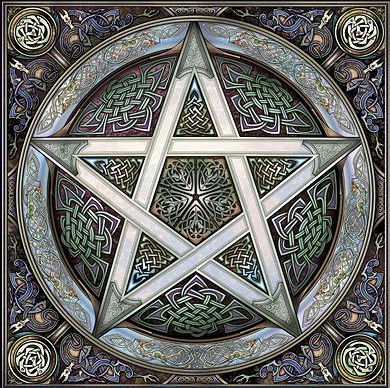
picture shows the bread cut into five sections, making a pentacle.
Place
onto a greased baking tray and pop your buttermilk bread into a moderate oven
for about 20-25 minutes. Keep an eye on it. When the bread is ready it will
change color and it will sound hollow when you tap the bottom. Cool completely
on a wire rack. When it is cool, tie it with Lammas ribbon.
Take
time to concentrate on the bread you have created and turn the loaf three times
saying, “From the fields and through the stones, into fire, Lammas Bread, as
the Wheel turns may all be fed. Goddess Bless.”
Now
take your bread and share it with your family and friends and pass on the
generous blessings of this bright and bountiful festival. Eat it fresh, as soon
as it is made if you can.
Collect the Seeds of Future Harvest
Involve
children if you can. Collect and dry them in the sun, ready for next year’s
planting. Consider giving them as gifts at Samhain or Yule. Seeds are such
amazing and mysterious things – each tiny seed contains within it the blueprint
for the whole plant it will become. It will mirror its mother plant, the mother
that raised the seed and returned it to the earth with the help of the light of
the sun. It’s a miracle every time.
Above all:
Have Fun, Give Thanks and Celebrate.


 Learning Wicca and the Tradition of the Craft