Yule Recipes

Bourbon-Rosemary Almonds – 3 cups

Ingredients

  • 3 cups whole almonds
  • ⅓ cup minced fresh rosemary
  • 2 tsps ground cumin
  • 1 tsp coarse salt
  • ¼ tsp ground cayenne pepper
  • 1 cup firmly packed light brown sugar
  • ¼ cup burbon
  • 2 tbsps water
  1. Preheat oven to 375
  2. Place almonds in a single layer on a baking sheet and toast in the oven until golden and fragrant, about 15-20 minutes. Remove and set aside.
  3. In a small bowl, combine the rosemary, cumin, salt, and ground cayenne pepper. In a saucepan, bring the brown sugar, bourbon, and water to a boil over medium heat. Continue boiling for 10 minutes. Add the almonds and stir to coat them completely. Stir in the seasonings and mix well. Transfer the nuts to a buttered baking sheet and separate with a fork while they’re still warm.
  4. Cool before serving. Store in a container with a tight lid.

Latkes – Serves 4

Ingredients

  • 4 potatoes
  • 1 apple, any variety
  • 1 tbsp grated onion
  • 1 large egg
  • ⅓ cup all-purpose flour
  • ¾ tsp salt
  • ⅓ cup vegetable oil
  • Sour cream OR applesauce OR cream cheese OR fruit preserve for garnish
  1. Peel the potatoes and grate them very finely, which should leave about 3 cups. Squeeze some of the moisture out of the grated potatoes. Peel, core, and finely grate the apple and add it to the potatoes. Add the onion, egg, flour. And salt. Beat until mixture is well blended.
  2. Pour ½ inch of oil into skillet. When the oil is heated, drop in the batter by heaping tablespoonful. Fry until crisp and golden brown on both sides. For crispiest cakes, fry in very hot oil, turning only once. Using moderately warm oil and turning them often leaves the latkes soggy. Remove them and drain them on paper towels. Serve immediately with garnish of choice.
  3. If you choose to freeze some for later, fry the latkes on each side until they are only slightly golden brown. Drain them on a paper towel. Place the latkes flat in a single layer on an aluminum foil-lined baking sheet. To serve, bake at 425 for 5-10 minutes until crisp.

Chakra Cranberry Sauce – serves 12

Ingredients

  • 1 cup water
  • 1 cup granulated sugar
  • 1 ½ cups fresh cranberries
  • 1 orange, peeled and pureed 
  • 1 apple, peeled, cored, and diced (any variety)
  • 1 pear, peeled, cored, and diced (any variety)
  • 1 cup dried mixed fruit, chopped
  • 1 cup pecans, chopped
  • ½ tsp salt
  • 1 tsp ground cinnamon
  • ½ tsp ground nutmeg
  1. In a saucepan, boil the water and sugar until the sugar dissolves. Reduce the heat to simmer and stir in the cranberries, orange, apple, pear, dried fruit, pecans, salt, cinnamon, and nutmeg.
  2. Cover and simmer for 30 minutes, stirring occasionally, until the cranberries burst. Remove from heat and let cool to room temperature.

Wheel of the Year Soba and Tofu – Serves 4

Ingredients 

  • 2 qts water
  • 6 green onions, white and greens separated, greens cut into 2 in. lengths and sliced lengthwise
  • 1 oz fresh ginger, peeled and sliced
  • 3 cloves garlic, crushed
  • 1 tbsp grapeseed oil
  • 1 (14 oz) package extra-firm tofu, drained and pressed
  • Salt and pepper
  • 2 tsps soy sauce
  • 6 oz soba noodles
  • 1 head bok choy, trimmed and thinly sliced
  • 4 oz snow peas, trimmed and halved
  • 1 red serr chile pepper
  • 1 tsp black sesame seeds
  1. In a put with the 2 qts water, add the onion whites, ginger and garlic and bring to a boil. Cover, reduce to simmer, about 25 minutes.
  2. In a separate saute pan, warm the oil over medium heat. Slice the tofu in half and season it with salt and pepper. Saute the tofu on all sides, about 15 minutes. Remove the tofu from the pan and set aside to cool; when it’s cool enough to handle, slice the tofu into small cubes.
  3. Using a slotted spoon, remove the onion, ginger, and garlic from the pot; compost the solids. Bring the broth to a boil; add the soy sauce and soba. 
  4. Cook the soba for 1 minute or until al dente. Add the bok choy, snow peas, and the chile pepper. Cook until the vegetables are tender-crisp.
  5. To serve, place the noodles in a bowl with the broth; top with tofu, onion greens, and sesame seeds.

Note: Store black sesame seeds in the refrigerator to avoid spoiling.

Caraway Breadsticks – 3 dozen breadsticks

Ingredients

  • 1 ¼ oz package active dry yeast
  • 1 cup warm water
  • 1 tbsp granulated sugar
  • ½ tsp grated nutmeg
  • 1 tbsp chopped fresh sage leaves
  • 1 tsps caraway seeds
  • 1 ½ tsps salt
  • 1 large egg
  • ¼ cup vegetable shortening
  • 3 ¼ cups all-purpose flour
  1. Blend the yeast and ¼ cup warm water. Let stand for 5-10 minutes, until foaming. Mix in the remaining water, sugar, nutmeg, sage, caraway seeds, and salt. Add the egg and the shortening, beating vigorously with a spoon. Sift in the flour, mixing well. Cover and refrigerate for at least 2 hours or overnight.
  2. Divide the chilled dough into 3 dozen small pieces. Roll eight 1 inch pencil-like strips and place then 1 inch apart on a greased baking sheet. Let rise for 1 ½ – 2 hours.
  3. Preheat the oven to 400F. Bake the breadsticks for 12-15 minutes.

Lambs Wool Apples – serves 4-6

Ingredients

  • 2 cups granulated sugar
  • ½ cup water
  • 1 tsp grated nutmeg
  • 1 tsp ground ginger
  • 1 stick cinnamon
  • ¼ tsp mace
  • 3 whole allspice berries
  • 6 large eggs, separated
  • 6 cups beer or ale
  • 1 cup brandy
  • 1 cup cream sherry
  • 6 baked apples
  1. In a small saucepan, combine the sugar, water, and spices. Bring to a boil, reduce heat, and simmer for 5 minutes. 
  2. In a small bowl, beat the egg whites until they stand in soft peaks. In a separate bowl, beat the egg yolks until slightly thickened and paler yellow. Fold the egg whites and yolks together. Using a very large pot, gradually fold the spice mixture into the egg mixture.
  3. In another saucepan, heat the beer, brandy, and sherry. Slowly add the alcohol to the egg and spice mixture. The result should be light and foamy, giving it the name of Lambs Wool Apples. Halve the baked apples and float them on top. Serve warm.

Yule Turkey – serves 15-20

Ingredients

  • 1 turkey, 18-22 lbs
  • 2 large oranges, cut in half
  • Salt and pepper
  • 1 cup unsalted butter, softened
  • 3-4 tsps crushed garlic, or to taste
  • Paprika
  • 4 tbsps vegetable oil

Stuffing

  • 2 loaves presliced white bread
  • 2 tbsps butter, softened
  • Turkey giblets and neck
  • 1-2 chicken bouillon cubes
  • Salt and pepper
  • 1 tsp granulated sugar
  • 1 cup chopped celery
  • 1 (4oz) can black olives, chopped
  • 1 ½ cups raisins
  • ¼ cup chopped green onions, all parts
  1. Remove giblets and neck for stuffing
  2. Preheat oven to 325F. Wash the turkey well, inside and out. Dry the turkey, inside and out, with paper towels. Squeeze the oranges over the turkey and rub some of the juice on the inside of the turney cavity. Season the cavity with salt and pepper. Fill the turkey with stuffing. Close the turkey either by sewing it or using trussing skewers. Rub the outside of the turkey with ¾ cup of the butter and smear the crushed garlic all over it as well. The butter acts as a basting juice during the first half of the cooking time. Season the turkey with salt and pepper then sprinkle paprika all over it. Drape the turkey with cheesecloth. Place the turkey, breast side up, on a rack in a roasting pan. Place the turkey in the oven (see note).
  3. Melt the remaining butter and the vegetable oil in a small saucepan. Lift the cheesecloth every 30 minutes to baste the turkey with the butter mixture. Basting is most important, so do not neglect it! After a while, you can baste with the turkey’s own juices. Use a meat thermometer to check for doneness. A turkey is done when the thigh juices run clear yellow when pricked, there are no traces of pinkness, and the drumstick moves easily in it’s socket. Allow the turkey to stand for 30 minutes. Transfer the stuffing to a bowl and keep warm. Carve the turkey and serve.

Note: Turkey roasts for about 20-30 minutes per pound, so you’ll need to cook this one for 9-11 hours. Use a meat thermometer and cook it until the thermometer registers the proper temperature for poultry (180F). Remember to allow plenty of cooking time before you plan to serve the turkey.

Stuffing

  1. The night before roasting the turkey, toast and lightly butter all of the bread. After you’ve toasted it, tear off small bite-sized pieces and toss them into a very large skillet. Cook on medium heat and lightly brown the bread pieces until crunchy. Let sit overnight, uncovered.
  2. The next morning, remove the giblets and neck and wash them. Boil them in 3 cups of water for 1-2 hours in a large saucepan. Add the bouillon. After boiling, save the broth. Remove the giblets and neck and chop them into small pieces (You may only want to use ½ of the cut meat).
  3. Heat the bread crumbs you prepared the night before. Slowly pour about ⅓ – ¼ of the broth over the bread, and start to mash the bread mixture with the back of a large spoon. Add the salt, pepper, and sugar, Continue adding broth in small increments, but do not add too much water or it will be soggy; not enough and you can’t mash it. As you blend in the water, add the celery, olives, raisins, giblets, turkey neck, and green onions. Mix it all together and set aside for 10 minutes before you stuff the turkey.

Stuffed Turkey Burgers – 4 burgers

Ingredients

  • 1 lb ground turkey
  • ½ cup chopped fresh thyme
  • 2 tbsps bread crumbs
  • Dash of salt
  • Juice of ½ lemon
  • ½ cup crumbled blue cheese
  • ½ tsp lemon zest
  1. In a large bowl, mix the turkey, thyme, bread crumbs, salt, and lemon juice. Separate the turkey mixture into 4 parts. Then, form each part into 2 balls. Flatten each ball into a patty. On top of the 4 patties, place 2 tbsps of the blue cheese and a pinch of the lemon zest. Cover with the remaining 4 patties and seal the edges by pressing the layers together. This creates four large stuffed burgers. Refrigerate for 1 ½ hours. Grill to desired doneness. 

Yuletide Treats– About 2 dozen cookies

Ingredients 

  • ½ cup firmly packed light brown sugar
  • 3 tbsps butter, softened
  • 1 large egg
  • 1 cup all-purpose flour
  • ½ tsp baking powder
  • ¼ tsp baking soda
  • ½ tsp ground cardamom
  • 2 tsps pumpkin or apple spice
  • Red and green icing or sprinkles, for decoration
  1. Preheat the oven to 375F. In a large bowl, cream the brown sugar and butter until well blended. Beat the egg separately. Add the egg, beating until well blended. Lightly ladle flour into a measuring cup; level off.
  2. Mix the flour, baking powder, baking soda, and spices in a bowl. Slowly add the flour mixture to the egg mix, mixing well.
  3. Divide the dough in half. Turn the dough out on a lightly floured surface. Using your hands or a rolling pin, elongate the dough into a log no more than 1 inch wide. FLatten slightly to 1 ¼ inches in diameter.
  4. With a spatula, place the logs 2-3 inches apart on an ungreased baking sheet. Dip a nonserrated knife in water. Make ¼ inch diagonal slashes at ¾ inch intervals. Either decorate with sprinkles now or with icing later. Bake for 11-13 minutes, until set and no longer moist. Cool for 1 minute.
  5. Remove the logs from the baking sheet and place on a wire rack. Cool for 5 minutes.
  6. Slice the logs at the scored lines with a serrated knife. Cool completely. Decorate each cookie with decorator icing to resemble a holly leaf and berries.

Hot Ginger Tea – serves 4

Ingredients

  • 1 large piece fresh ginger, sliced
  • 1 stick cinnamon
  • Several lemon slices
  • Several whole cloves
  • 4 cups water
  • ¾ cup firmly packed light brown sugar or honey
  1. Press the cloves into the lemon slices. In a saucepan, combine the ginger, cinnamon, lemon slices, and water. Bring to a boil. Reduce the heat, and simmer for 15-20 minutes. Sweeten with brown sugar or honey, to taste. Strain and serve hot.

Glüwein – serves 12-14 

Ingredients

  • 8 cups cabernet, sauvignon or other hearty red wine
  • ½ cup granulated sugar
  • 8 sticks cinnamon
  • 4 slices oranges or lemon peel
  • 1 tbsp freshly squeezed lemon juice
  • 2 tbsps freshly squeezed orange juice
  • 12 whole cloves
  1. Mix all ingredients in a large saucepan. Cover and simmer for at least an hour.

Note: For children and a more diluted alcoholic version, simmer for 30 minutes, covered, then boil, uncovered for 10 minutes. Some of the alcohol will remain, but much will evaporate using this method.

Yule History, Crafts, and Rituals (Repost)

Yule comes from the old Norse jól and Old English géohol which was a season of hunting after the harvest was done. This fell in what we now call December so it eventually became associated with the Christmas Holiday. The first recorded use of the noun Yuletide, according to Wikipedia, was in 1475. The Yuletide season lasted from the end of November to the beginning weeks of January but the feast of Yule lasted three days over the Winter Solstice and marked the beginning of the new year.

Yule was similar to Passover in Jerusalem before the Temple was destroyed. For Passover, the Jewish people would bring lambs, birds, and other animals for sacrifice. The blood would be offered on the altar and the meat cooked for the Passover meal. According to Norse historian and saga translator Lee M. Hollander every nine years Germanic (Norse) farmers were compelled to come to the temple hof and make sacrifices and feasts over a prescribed period of time during yuletide. Yule was celebrated in Germanic countries with animal sacrifices where the sanctified blood was then used to paint the altar, temple posts, and the supplicant himself as part of the ritual. He was literally “washed in the blood”. This was followed by feasts, storytelling and drinking around a large communal fire. In Grettis Saga Yule is described as a time of “greatest mirth and joy among men.”

This was also a time of oath-making. Business deals and marriages were brokered. The godi (priest, judge, chieftan) who was in charge of the hof wore a great gold ring around his neck. The people who would swear an oath, laid their hands on this ring and made their pledge in front of witnesses. Just such a ring was found at an excavation of an 11th century chieftain’s residence on the outskirts of Tissø, Denmark

The most famous hof was uncovered at Uppsala, Sweden. The same temple is mention in the Heimskringla, by Snorri Sturluson and in Adam of Bremen’s 11th century travel journal. It is described as housing three statues on three thrones, one for Thor, one for Wodan(Odin) and one for Fricco(Freyr). There was a great gold chain around the building, draping from the gables that flashed in the sunlight from afar. Other traveler’s accounts also mention this chain. In the Ynglinga Saga by Snorri Sturluson, Uppsala was the site where King Domalde was sacrificed in the Autumn after three years of famine, for the sake of his people, and prosperity returned. The first day of Yule falls on the last day of Autumn.

In the Saga of Hákon the Good, Haakon I of Norway changed the date of Yule from the days surrounding Midwinter to the date that Christmas was observed in the rest of Europe. Though the sacrifices and religious practices of Yule were abandoned, many Yuletide customs continued.

Yule Log

Eventually many Yule customs were absorbed into Christmas celebrations as Christianity overtook Northern Europe. The oldest was the tradition of the Yule log which echoed with sacrificial significance. Originally it was a whole tree or a large tree trunk that was carefully chosen, felled and hauled to the long house with great ceremony. Then the end of the trunk was laid on the hearth and lit with a brand from the previous year’s yule fire as the rest of the tree stuck out of the hearth into the room. The tree trunk was pushed into the hearth as it burned, which it did continuously for 12 days from Christmas Eve to Epiphany. At the end, the unburned part of the tree was extinguished and saved to start the fire next year. In Holland, they believed that storing the leftovers of the Yule log under a bed would protect the home from lightning strikes. No doubt a nod to Thor.

The Bûche de Noël is a French tradition that celebrates the Yule Log in the form of a fancy dessert made of thin sheets of sponge cake spread with buttercream frosting then rolled to form a log. The Bûche de Noël is then decorated with chocolate frosting bark, candy holly leaves, and meringue mushrooms.

The Yule Goat

Thor was said to have a chariot that was pulled across the sky by two goat bucks. During Yule they would either bring gifts to well behaved children or demand gifts on behalf of Thor. Over time the julbock became jultomte who was a combination Yule Goat/Santa Claus/Father Christmas who would bring gifts and drive a sleigh pulled by reindeer, not goats.

The Yule Ham

Just as the goat was associated with Thor, the boar was associated with Freyr. Pigs and wild boar were sacrificed to Freyr to grant a bountiful harvest or to bless marriages and children. After the sacrifices were made during a Norse Yule, the meat was boiled and eaten at the feast. In the middle ages, the boar’s head was considered the best part and it was served to the head table with an apple in its mouth. Today the vestiges of this tradition are found in the Christmas Ham and the Boar’s Head Carol.

Wassail translates as “Good Health” as in “I drink to your good health”, but it was also the alcohol punch made with spices and fruit juice that was used to make the toast. The word toast comes from the toasted bread served with the brew. If it also contained eggs, milk or cream it was called nog. To go a-wassailing was like trick-or-treat for grown-ups. They would go from house to house and beg for wassail and other treats, like figgy pudding. The tradition originated before Christianity as an orchard blessing ritual. The people believed that the fruit trees went into hibernation when the nights grew longer. So they would gather in the orchards after Mid-winter and make as much noise as they could to wake up the trees.

Let every man take off his hat

And shout out to th’old apple tree

Old apple tree we wassail thee

And hoping thou will bear.

Over time it became an excuse for drunken revellers to wander the streets singing loudly. The modern tradition of caroling for hot chocolate and eggnog is all that remains of this old Yuletide tradition. Here is a good traditional recipe for Wassail from the Nourished Kitchen.

Mistletoe

Mistletoe was greatly revered by the Ancient Druids and the Norse people believed it was magical. It stayed green all year round even though the host tree would drop its leaves and look dead. It drew in nutrients without any roots in the earth. It was always found high up in oak and apple trees. If found in a sacred oak tree, it was cut down with a gold sickle during a special ceremony and caught in a white cloak before it hit the ground. Then the magical mistletoe was divided and a piece was given to every home in the village to ward off evil for the next year. Thus hanging mistletoe over the door became a New Year’s tradition. According to About.com kissing under the mistletoe is related to Frigga also known as Freyr

The Norse goddess of love was Frigga. Frigga had two sons, one of which was blind. The evil figure of Loki made an arrow out of mistletoe wood and shot Frigga’s blind son with the mistletoe arrow. The blind son died, and the goddess’ tears became the mistletoe’s white berries.

When Frigga’s blind son came back to life later, the Nordic goddess decided to turn mistletoes in Scandinavia into a symbol of love and fertility, requiring a kiss between humans meeting beneath the mistletoe.

 (Above courtesy of https://stores.renstore.com/ )

Make Your Own Yule Ornaments

If you want to bring the spirit of the Yule season into your home, there are few better ways than by making your own holiday ornaments! Monotheistic religions don’t have a monopoly on winter celebrations, so if you’ve got a tree to decorate, you can make some simple ornaments to help you rejoice in the winter solstice season.

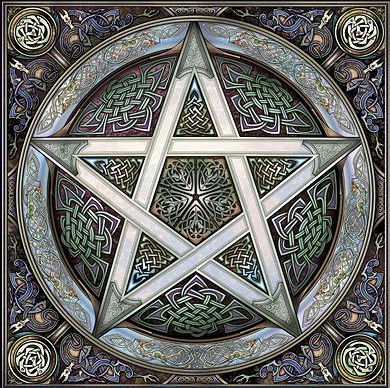
Make salt dough decorations in Pagan-friendly shapes like suns, moons, and stars. You can use cinnamon and applesauce to make spell ornaments for healing, prosperity, or love. Want to keep an earth-friendly theme to your Yule decorating? Why not use the elements found in nature as part of your decor? Decorate a pine cone with simple things such as seeds, acorns, feathers, and other found items – all of which are easy to make into ornaments and other decorations. Bend a few chenille stems together to make a simple pipecleaner pentacle, or fill an empty glass ornament with magical items to create a spell bottle that you can hang right there on your Yule tree!

  • Cinnamon Stick Bundles – Bundle a few short cinnamon sticks together using a bit of slender ribbon and tie a bow and a loop at the top.  Then glue on little sprigs of holly, pine or dried flowers like rose buds, marigolds or baby’s breath, tucking the stems under the bow.
  •  Bay Balls – Take some Bay leaves.  Fresh is best but if all you have is dried, then soak them overnight in warm water to make them pliable (that means you can bend them more easily without breaking them).  The next morning, pat them dry.  Next, take a Styrofoam ball and use Tacky Glue to cover it with bay leaves.  Start at the bottom of the ball and work your way toward the top so they overlap a bit.  Some of the leaves you may have to hold in place while the glue dries so they don’t pop up. Cloves or rosebuds stuck through the leaves into the ball will help hold the leaves in place and look pretty besides.  A very pretty effect is to “dust” your finished ball with a light spray of gold paint.  Pin a pretty loop of ribbon or gold cording to the top to hang it by.
  • Pinecone Ornaments – If you have pine trees in your area, collect the fallen cones.  If not, you can buy the cones in a craft store.  Cover the very edges of the pinecone with glue and sprinkle glitter over the glue. It will look like the cones are tipped with frost – very pretty! You can also simply spray paint the cones gold or silver and then immediately sprinkle them all over with iridescent glitter. Pinecones are light enough to just tuck into the tree’s branches or you can glue on a ribbon loop to hang it with or twist a loop of wire around the base.
  • Cinnamon Stick Pentagrams – (this project uses hot glue, so parents might wish to help younger children) Soak 5 cinnamon sticks (each about the same length) overnight in warm water.  In the morning, pat them dry and form them into a pentagram. The soaking will make them pliable so that as you overlap them, they will bend more easily.  Hot glue the ends together and then wrap the ends also with twine or raffia and tie it off.  Use extra raffia to create a loop at the top for hanging.
  • Yule Sachets – Take about a 4 inch square of lace or fabric (if you’re going for a very “organic”, natural look for your tree, then burlap works well)  In the center, put a tablespoon of Yule sachet mixture,  bring the ends of the fabric up and tie ribbon or twine around the top making a little pouch with the herbal mixture inside.  Tuck a sprig of holly, mistletoe or little birch pinecones into the ribbon. If you can find a rubber stamp at the craft store with a sun, star or moon on it, you can stamp the outside of the fabric with a picture before adding your herbs.
    • Yule Sachet Mixture – 2 parts fragrant pine leaves, 1 part rosemary, 1 part cinnamon, 1 part cloves, 1 part dried orange peel broken into little pieces.   Add a bit of cinnamon oil; stir it up good and let it sit for a few days in a closed jar.
  • Pomanders – Tie a loop in a length of ribbon leaving the ends long enough to wrap around a small orange, lime or lemon.  Wrap it around the fruit and then tie it at the bottom.  If you want you can cut the ends off, let them dangle or even add a tassel. Then, poke large cloves all over into the fruit.  You can use a nail, wooden skewer or even an old crochet hook to get the holes started if you want.  Completely cover the fruit with the cloves or create a pattern with some of the fruit showing through.
  • Gilded Acorns – Often, when you find acorns on the ground, their little caps have come off.  If that’s the case, then collect both caps and bases.  If not, then remove the caps yourself when you get home.  Paint both halves with spray paint or craft paint using either gold or silver.  Then cut a slender ribbon about 3 inches long and glue each end to the inside of the cap so that it forms a loop.  Then glue the cap back on to the base of the acorn. When it’s done, you can paint the cap with watered down white glue and dust it with glitter.
  • Cinnamon Ornaments – Put about a cup of applesauce in a strainer and let it sit & drip for a few hours.  Then combine1 cup cinnamon with one tablespoon each of cloves and nutmeg.  Add 2 tablespoons of white glue and ¾ cup of drained applesauce. 
    • For a more intense fragrance, you can add about ¼ teaspoon of cinnamon and/or apple oil.  Mix it all up with your hands until its a smooth ball, all mixed up.   (be careful to wash your hands after handling the oils.  You don’t want to accidentally get any in your mouth or eyes). Roll it out about ¼ inch thick and either cut shapes out with cookie cutters or use the templates below.  Use a straw to poke a hole in the top. Let them sit out to dry for a few days, turning them over once or twice a day so they don’t curl up. Then, poke a ribbon through the hole to hang them with.

Yule Smudge Sticks

When Yule rolls around — December if you’re in the northern hemisphere, or in June for our readers below the equator — one of the most notable aspects of the season is that of the scents and smells. There’s something about our olfactory system triggering certain memories and recollections, and the Yule season is no exception. Aromas like pine needles, cinnamon, mulled spices, frankincense – all of these are reminders of the winter holidays for many of us.

Smudging is a great way to cleanse a sacred space, and most people use smudge sticks made of sweetgrass or sage for this purpose, but why not use more seasonally appropriate plants at Yule?

Some types of plants definitely work better than others. For instance, certain members of the fir family begin to drop their needles as soon as they begin to dry, which means you’ll end up with needles all over your floor, and not in your smudge stick if you use them. On the other hand, the trees with the longer, softer needles seem to work really well, and lend themselves nicely to a project like this.

Here’s what you’ll need:

Scissors or garden clippers

Cotton string

Seasonal plants such as evergreens (pine, fir, juniper, balsam, and cedar), as well as other scents you find appealing – try using rosemary in addition to the pine, fir, and juniper.

Trim your clippings down to a manageable length, between six and ten inches, but if you’d like to make shorter smudge sticks, go right ahead. Cut a length of string about five feet long. Put several branches together, and wind the string tightly around the stems of the bundle, leaving two inches of loose string where you began. Tie a knot when you get to the end, and leave a loop so you can hang them for drying. Depending on how fresh your branches are – and how much sap is in them – it can take a few weeks to dry them out. Once they’re done, burn them in Yule rituals and ceremonies, or use them for cleansing a sacred space.

Winter Nights Incense

Scents have a way of making time stand still for us sometimes, and the aromas of the winter holidays are no exception. For many people, re-creating the smells and emotions of our childhood, or even of some distant ancestral memory, is part of the magic of the Yule season.

To make your own magical winter night’s incense, first determine what form you’d like to make. You can make incense with sticks and in cones, but the easiest kind uses loose ingredients, which are then burned on top of a charcoal disc or tossed into a fire. This recipe is for loose incense.

If you have friends who might enjoy making incense with you, invite everyone over for an incense blending party. Ask each guest to bring an herb or spice of their choice, and stock up on spoons, bowls, and small jars – baby food jars are perfect for this – ahead of time. Once everyone has combined their ingredients, divide them up evenly and spread the love!

Magical Gingerbread Poppets

As Yule rolls around, many of us get into crafting mode – and that is as good a time as any to work a little holiday magic. Why not take the holiday tradition of gingerbread men, and turn it into a practical poppet working?

A poppet is essentially a magical doll, designed to represent a person – traditionally, they’re made from cloth or some other sort of fabric. Because we’re not going to eat these, we’ll simply be making them from felt and other craft materials, and stuffing them with magical ingredients.

Then you can give them as gifts, hang them on your holiday tree, or put them around your house.

Here are just a few ideas for magical gingerbread poppets that are appropriate for the holiday season:

Love poppet: Make a poppet to represent the object of your affection — remember that in some magical traditions it’s frowned upon to make a specific person the target of your working. If you are simply trying to attract love to yourself, but you don’t have a specific person in mind, focus on all the desirable qualities you want to see in a potential lover. Stuff your poppet with small bits of rose quartz, rose petals, parsley and peppermint.

Prosperity poppet: The holiday season is a good time to focus on prosperity. Fill the poppet with a bit of cinnamon, orange, or ginger, and maybe even a small coin to get the message across.

Healing poppet: When you make this poppet, be sure to indicate what – and whom – you are trying to heal. Focus all of your energy on the ailment in question. Fill with lemon balm, feverfew, ivy, and pine, as well as bits of turquoise and bloodstone.

Protection poppet: Create poppets that represent each member of the family, blending herbs and stones into the clay. Use hematite and amethyst, as well as basil, patchouli, and coffee for filling.

Finally, decorate your gingerbread poppet with craft paint, fabric scraps, buttons, or other embellishments. Stitch a loop of ribbon into the head so you can hang him or her on your Yule tree – or give it to a friend!

Yule Herbal Sachet

Herbal sachets are a great way to use up bits of scrap fabric, and they have the added bonus of making your home smell amazing! A sachet is simply a cloth pouch or bag stuffed with aromatic blends of herbs, flowers, or other goodies. Believe it or not, there’s a rich history behind the use of herbal sachets. You can place herbal sachets in your dresser drawers to give your clothing a soft seasonal scent, or tuck them under your pillow, so you can breathe in the aromas of Yule as you fall asleep. 

Use one of the sacred plants associated with the Yule season, such as mistletoe, holly, or evergreen boughs to make a herbal sachet.

Yule Simmering Potpourri

Bring the scents of Yule into your home by blending up your own batch of potpourri. Keep it in a Mason jar so it will stay fresh. To use, simply scoop a half cup of mix into a small pot, and cover with a few inches of water. Allow to simmer on low heat on your stovetop, adding water as the potpourri reduces down. You can also use a small potpourri-sized crock pot. 

Blend together:

3 Cups dried orange peel

1 Cup dried lemon zest

4 Cinnamon sticks, snapped into thirds

1/4 Cup whole cloves

1/4 Cup pine needles

A pinch of allspice

10 juniper berries

Mix in a bowl and then keep in a tightly sealed jar until you’re ready to use it. If you’re feeling really crafty, make a big batch, divide into several jars, and then tie with a decorative ribbon or piece of raffia. Add a note card, and give as gifts for your friends at Yule!

Yule Greeting Cards

It’s hard to find Yule greeting cards commercially, and often when you do locate one you like, they can be expensive. Because there’s not a huge market for Pagan greeting cards, even during the Yule season sometimes it’s just easier to make your own. With a little imagination—and a couple of kids to help out if possible—it’s really easy to make stylish Yule cards that your friends will love. You can make a couple of different kinds of cards, depending on how much time you have, and your level of craftiness.

Before you get started, make sure you have craft supplies on hand. Things like card stock in a variety of colors, stamps, paint, ink pads, and markers will all make it easy to create your own cards. Glue, paste and glitter are useful too.

RUBBER STAMP GREETING CARDS

You’ll need card stock in the colors of your choice, an ink pad, a rubber stamp with some sort of Yule theme to it—a blazing sun, pinecones, a stag, even Stonehenge—and a paint marker or calligraphy pen. One the front of your card, use the rubber stamp and ink pad to create a Yule design. On the inside, use the paint marker or calligraphy pen to write a simple Yule greeting, such as Solstice blessings from our family to yours or May the light of the Sun shine on your family this Yule season.

SNOWFLAKE CARDS

This is a lot of fun if you have small children. Get a pile of cardstock in different colors, and some white paper and scissors. Fold the white paper into eighths, and have your kids cut out snowflakes. Then glue the white snowflakes onto the front of the cardstock. Use your paint marker or calligraphy pen to write a Yule greeting on the inside. Remember, snow can be magical!

SILLY SUN CARDS

Cut out circles of yellow construction paper, and thin strips in yellow and orange. Paste a circle in the center of the front of a card, with the strips radiating out from behind it like the rays of the sun. Once the glue has dried, have your kids draw funny faces on the suns. Write a greeting on the inside of the card.

STAINED-GLASS CARDS

You’ll need black card stock for this one, as well as a variety of bright colors to create your design. Create a sun or other design by cutting small pieces in bright colored paper. Place them on the black card stock, leaving black lines between the colored pieces, creating a mosaic or stained-glass effect. On the inside, paste a light-colored strip of paper for the written greeting.

KRAMPUS CARDS

The legend of the Krampus has become part of pop culture in the past few years, so why not send out a Krampus card? Find an image of the Krampus that you like, attach it to the front of a blank greeting card, and mail them out to your friends!

COMMERCIALLY AVAILABLE CARDS

Although you probably can’t find too many options when it comes to Pagan greeting cards in the big-box discount stores, with a little digging, you can find a lot of independent artists who have created Yule cards. Another great place to check? Your favorite metaphysical or witchy shop — and don’t rule out the clever, creative folks on Etsy! 

Winter Solstice Oil Blend

This is a fairly simple blend of oils, and is designed to evoke the scents and smells of the winter holiday season. As you’re mixing it, picture what it must have been like for your ancestors, seeing the sunlight burst onto the horizon on the winter solstice, hundreds and even thousands of years ago. Consider how cold they must have been, with only the glow of a fire to warm them, on the longest, darkest night of the year – and the relief they must have felt at the return of the sun.

To make Winter Solstice Oil, use 1/8 Cup grapeseed oil or other base oil of your choice. Add the following:

4 drops pine oil

2 drops orange oil

2 drops cedar oil

2 drops juniper oil

2 – 3 small lumps of frankincense, finely ground

As you blend the oils, visualize your intent, and take in the aroma. Know that this oil is sacred and magical. Label, date, and store in a cool, dark place. Use during your Yule celebrations to anoint participants or tools, or simmer on an aromatherapy burner.

Make a Tree Topper from Found Natural Items

If your family puts up a holiday tree, it can sometimes be hard to find just the right tree topper. After all, you may not be into angels, Santa Claus might not be your thing, and some of those gold stars are pretty floppy. So why not celebrate the natural aspect of the season, and make a tree topper out of the gifts the earth provides?

Collect an assortment of the following:

Sticks – try to find five with a similar diameter

Nuts, berries or acorns

Small pinecones, dried fruits or cinnamon sticks

Feathers

Vines, bark or dried moss

You’ll also need some raffia or cotton string and a hot glue gun.

Cross the sticks over one another to form a star. Use a dab of hot glue to hold them in place while you wrap the raffia or string around the intersections of the five sticks.

Add nuts and berries, pinecones, feathers or pieces of bark to embellish your star. Tie a piece of raffia or string into a loop at the top, and hang your star on the top of your tree.

Wigington, Patti. “Yule Craft Projects for the Winter Solstice.” Learn Religions, Aug. 28, 2020, learnreligions.com/yule-craft-projects-4147322.

About a month before Yule rolls in, start thinking about all the clutter you’ve accumulated over the past year. You’re not obligated to keep things you don’t like, don’t need, or don’t use, and the less physical clutter you have laying around, the easier it is to function on an emotional and spiritual level. After all, who can focus when they’re constantly having to step over piles of unused junk? Do this ritual to help clear out your physical space in the weeks before Yule arrives.

If you’re one of those people who feels bad about getting rid of stuff, donate it to a charity if it’s still clean and in usable condition. Many organizations do coat and clothing drives this time of year; look for one in your area. If you haven’t worn it, used it, played with it, listened to it or eaten it in the past year, pitch it.

Before you start decorating for Yule, you’ll want to get things organized. If you’re not organized yet, now’s your chance to get there. Each member of the family should be responsible for their own belongings. Sort your belongings so they’re in a place you can find them later, in a way that makes sense to you AND your family members.

If your home has a common area like a family room or kitchen that tends to attract clutter, get a basket for each person who lives there. Throw all their stuff in their basket — the next time they go to their room, they can take all their stuff with them to put it away.

Do you get magazine subscriptions? Newspapers? Create a place that’s a permanent home for them — a basket in the bathroom, a drawer in the kitchen, wherever people read. Then get into the habit of only keeping the last two issues of each. Recycle the old ones as new ones come in. Remember, the floor is not a storage place. If you can’t get something put away, get rid of it.

Clean your windows. You’d be amazed what a good window washing can do for your house, to say nothing of the way you feel. Mix a cup of vinegar with a gallon of warm water and spray down your windows, inside and out. Wipe them off with old newspapers. If you can’t stand the smell of vinegar, toss some lemon verbena or lemon balm in the mixture. If you have curtains, take them down and launder them. Throw a bit of dried herb, such as sage or rosemary, into a cloth baggie and add them to the rinse cycle.

If your windows have mini-blinds, dust them and wipe them down. If it’s warm enough outside, take them outdoors and spray them with your garden hose. Let them dry completely before hanging them back in. While you’re cleaning the windows, do your mirrors too, using the same mixture as above. As you see your reflection in the mirror, visualize cleaning away negative energy from your life.

If you have carpets and rugs, sprinkle them with baking soda and give them a good hearty vacuuming. Make sure you move the furniture around and clean beneath each piece — it’s time to get all the yuck out of your house, and dustbunnies are notorious for getting in the corners under the couch. If you have an extender on your vacuum cleaner, use it to suck up cobwebs and dust from the ceiling fans, baseboards, and other hard-to-reach spots.

Use a broom to sweep out any little bits of dirt and grime — it’s also a symbolic way of sweeping negative energy out of your home. If you’ve got a filter on your home’s heating system, now’s a good time to replace it with a new, fresh one. Do you have hardwood floors instead of carpet? Use an environmentally-friendly cleaner to get rid of dirt and grime. Clean baseboards and other woodwork.

Get your bathroom clean. It’s a place in our house we try not to think about unless we’re using it, but there are few things more impressive than a clean bathroom. Scrub toilets, wipe down countertops, and spray out your bathtub.

Once you’ve got the physical stuff done, now it’s time to focus on the fun part. Smudge your home with one of the following:

Sage

Sweetgrass

Pine needles

Mistletoe

To do a smudging, start at your front door with your incense or smudge stick in a censer or bowl. Move the incense around each door and window, and go through each room, following along the lines of the walls. If you have multiple levels, continue up and down stairs as needed. Some people like to add a small incantation to the process, like this one:

Yule is here, and I smudge this place,

Fresh and clean, in time and space.

Sage and sweetgrass, burning free,

as the sun returns, so it shall be.

Once you’ve completed the smudging, sit back and enjoy the positive energy that comes with having a clean physical space.

Setting Up your Altar

Yule is the time of year when Pagans around the world celebrate the Winter Solstice. If you’re in the Northern Hemisphere, this will be on or around December 21, but if you’re below the Equator, your Yule celebration will fall in June. This Sabbat is considered the longest night of the year, and following Yule, the sun begins its long journey back to earth. Try some or even all of these ideas — obviously, space may be a limiting factor for some, but use what calls to you most.

Colors of the Season

Winter is here, and even if the snow hasn’t fallen yet, there’s a definite chill in the air. Use cold colors to decorate your altar, such as blues and silvers and whites. Also find ways to include the reds, whites and greens of the season. Evergreen boughs never go out of style, so add some dark greens as well.

Symbols of Winter

Yule is a Sabbat that reflects the return of the sun, so add solar symbols to your altar. Gold discs, yellow candles, anything bright and shiny can represent the sun. Some people even get a large pillar candle, inscribe it with solar symbols, and designate it as their sun candle. You can also add evergreen boughs, sprigs of holly, pinecones, a Yule log, and even Santa Claus. Consider antlers or reindeer, along with other symbols of fertility.

Try incorporating sacred plants associated with the winter solstice as well. Evergreen boughs like pines, fir, juniper and cedar are all part of the evergreen family, and they’re typically associated with themes of protection and prosperity, as well as that of a continuation of life and renewal. Hang a sprig of holly in your house to ensure good luck and safety to your family. Wear it as a charm, or make holly water (which you probably read as holy water!) by soaking leaves overnight in spring water under a full moon. Use birch branches to craft your own besom for magical workings, and in spells and rituals related to enchantments, renewal, purification, fresh starts and new beginnings.

Other Signs of the Season

There’s no limit to the number of things you can put on your Yule altar, as long as you’ve got the space. Consider some of these items as part of your Sabbat decor:

  • Fruit and nuts: add bowls of winter nuts, like walnuts, pecans, and hazelnuts, or fresh fruit such as oranges and apples, to your altar
  • Mistletoe, which symbolizes fertility and abundance, is often associated with the winter holidays around the world
  • Snowflakes, icicles, or even a bowl of snow can come in handy for wintertime magic
  • Candy canes: although they’re typically associated with the Christmas holiday, candy canes can be utilized in magic as a way to direct energy
  • Bells are often included in Pagan practice as a way of driving away evil spirits, but you can also use them as a method of bringing harmony to a magical space
  • Sun wheels and other solar symbols are a great way to establish your connection to the sun as it begins its long journey back to the earth

Wigington, Patti. “Setting Up Your Yule Altar.” Learn Religions, Aug. 28, 2020, learnreligions.com/setting-up-a-yule-altar-2562996.

The ancients knew that the winter solstice was the longest night of the year—and that meant that the sun was beginning its long journey back towards earth. It was a time of celebration, and for rejoicing in the knowledge that soon, the warm days of spring would return, and the dormant earth would come back to life. On this one day, the sun stands still in the sky, and everyone on earth knows that change is coming. Perform this ritual to celebrate the return of the sun.

A holiday celebration that began in Norway, on the night of the winter solstice it was common to hoist a giant log onto the hearth to celebrate the return of the sun each year. If your family enjoys ritual, you can welcome back the sun at Yule with this simple winter ceremony. The first thing you’ll need is a Yule Log. If you make it a week or two in advance, you can enjoy it as a centerpiece prior to burning it in the ceremony. You’ll also need a fire, so if you can do this ritual outside, that’s even better. This rite is one the whole family can do together.

If your family uses a holiday tree during the Yule season —and many Pagan families do—you might want to consider a blessing ritual for the tree, both at the time you cut it down and again before you’ve decorated it. Although many families use fake holiday trees, a cut one from a tree farm is actually more environmentally friendly, so if you’ve never considered a live tree, maybe this is a good year to start a new tradition in your house.

Yule is the time of the Winter Solstice, and for many Pagans, it’s a time to say goodbye to the old, and welcome the new. As the sun returns to the earth, life begins once more. This ritual can be performed by a solitary practitioner, either male or female. It’s also easily adaptable to a small group of people.

As the sun returns to the earth, life begins once more—it’s a time to bid the Crone farewell, and invite the Maiden back into our lives. This ritual can be performed by a group of four or more—clearly, it’s designed for at least four women, but if you don’t have that many, don’t sweat it—improvise, or allow one woman to speak all the roles. Likewise, If you have an all-male group, you could revise this rite so that it focuses on the battle of the Oak King and the Holly King, rather than the Crone and the Maiden. If you have a mixed group, make adaptations as necessary.

First, set up a Yule tree near the north side of your altar. Decorate it with lights and symbols of the season. If there’s no room for a tree, use a Yule Log instead. Cover the altar with a winter-themed altar cloth if possible, and in the center, three white candles in individual candleholders. The oldest female present should take on the role of High Priestess (HPs) to lead the ceremony.

Of the other women present, one represents the aspect of the Maiden, another the Mother, and a third the Crone. If you’re really into ceremony and symbolism, have the Maiden wear a white robe and stand in the east. The Mother can wear a red robe and stand to the south, while the Crone dresses in a black robe and veil, and takes her place to the west of the altar. Each holds one of the three white candles.

If you normally cast a circle, do so now. The HPs says:

It is the season of the Crone, the time of the winter goddess.

Tonight we celebrate the festival of the winter solstice,

the rebirth of the Sun, and the return of light to the Earth.

As the Wheel of the Year turns once more,

we honor the eternal cycle of birth, life, death and rebirth.

The Maiden then takes her candle and holds it while the HPs lights it for her. She then turns to the Mother and lights the Mother’s candle. Finally, the Mother lights the candle held by the Crone. The High Priestess then says:

O Crone, the Wheel has turned once more.

It is time for the Maiden to claim what is now hers.

As you lie down for the winter, she is born once again.

The Crone removes her veil and hands it to the Mother, who places it on the Maiden’s head. The Crone says:

The days will now get longer, now the Sun has returned.

My season has ended, yet the season of the Maiden begins.

Listen to the wisdom of those who have come before you,

and yet be wise enough to make your own way.

The Maiden then says:

Thank you for the wisdom of your years,

and for seeing the season through to its end.

You have stepped aside that the new season may begin,

and for this we give you honor.

At this time, the High Priestess should invite anyone who wishes to make an offering to the Goddess to come do so— offerings can be placed on the altar, or if you’re outdoors, in a fire. The HPs concludes the rite by saying:

We make these offerings tonight,

to show our love to you, O Goddess.

Please accept our gifts, and know that

we are entering this new season with joy in our hearts.

Everyone present should take a few moments to meditate upon the time of the season. Although winter is here, life lies dormant beneath the soil. What new things will you bring to fruition for yourself when the planting season returns? How will you change yourself, and maintain your spirit throughout the cold months? When everyone is ready, either end the rite, or continue on with additional rituals, such as Cakes and Ale or Drawing Down the Moon.

In many modern Pagan communities, an emphasis is placed on the idea of helping those in need. It’s not uncommon to attend a Pagan event in which guests are invited to donate clothing, canned goods, toiletries, books, and even pet care products. Donations are then presented to local aid groups, food pantries, libraries, and shelters. If you’re gathering up some sort of donations, good for you! Before you drop them off, why not invoke the elements to do a formal blessing of the donated items? This can be a great way to honor your deities and your Pagan community, as well as help others recognize what an important occasion it is.

Some Pagans do charitable works because it is part of their group’s standards. For instance, you may honor a god or goddess that expects those who have to help those who have not. Or maybe it’s time for a local harvest celebration, and you’d like to contribute something to celebrate the season of abundance. Perhaps your deity has blessed you in some special way, and to honor him or her, you want to share your good fortune with others.

Whatever your reason may be, if you’re gathering up some sort of donations, good for you! Before you drop them off — at the shelter, library, food pantry or wherever — why not invoke the elements to do a formal blessing of the donated items? This can be a great way to honor your deities and your Pagan community, as well as help others recognize what an important occasion it is.       

You’ll need the following items:

All of your donated materials

One candle for each person participating

Items to represent the elements of earth, air, fire and water

If your tradition requires you to formally cast a circle, do so now. However, because this ritual invokes the four elements, and thus the four directions, you may wish to skip this step if you’re pressed for time. Ask everyone who’s participating to stand in a circle around the donated items. You can place them on your altar if you like, and place that in the center.

Place each of the elemental markers in its corresponding location of the circle. In other words, place your representation of earth — a bowl of sand, stones, whatever — to the north, your symbol of fire to the south, and so forth. Ask a participant at each directional point to hold the item. Pass the candles around to the group so that each person has one of their own. Don’t light them just yet.            

Remember, you can adjust the wording in this ritual as necessary, to accommodate the needs and requirements of your group’s purpose.

The leader of the ritual begins with the following:

“We gather today to celebrate community.

To honor those who contribute selflessly,

Those who contribute what they have to those who have nothing,

Those who speak out for those who have no voice,

Those who give to others without taking for themselves.

Each of you has contributed something to this community today.

Whether it is a monetary donation, a packaged good, or simply your time,

We thank you.

We honor you for what you have given, and we celebrate these donations

By blessing them before they move on.

We call upon the elements to honor the many aspects of community today.”

The person standing at the north should take their bowl of earth or stones, and begin walking around the outside of the circle. Say:

“May the powers of Earth bless this donation.

Earth is the land, the home and the foundation of community.

Nurturing and solid, stable and firm, full of endurance and strength,

This is the base upon which we build our community.

With these powers of Earth, we bless this donation.”

Once the Earth person has returned to his or her spot in the circle, the individual holding the Air symbol, at the east, begins a rotation around the circle, saying:

“May the powers of Air bless this donation.

Air is the soul, the breath of life in a community.

Wisdom and intuition, the knowledge we share freely,

Air carries away troubles from our community.

With these powers of Air, we bless this donation.”       

Next, the individual holding the Fire symbol – a candle, etc. – at the south, begins moving around the group, saying:

“May the powers of Fire bless this donation.

Fire is the heat, the fertility of action, the bringing of change,

Strong will and energy, the power to get things done,

Fire is the passion that drives our community.

With these powers of Fire, we bless this donation.”

Finally, the person holding water begins to walk in a circle, saying:

“May the powers of Water bless this donation.

Cleansing and purifying, washing away ill will,

Carrying away with it need, want, and strife.

Water is what helps to keep our community whole,

With these powers of Water, we bless this donation.”

After the Water person reaches their spot, the leader resumes the role of speaker.

“We bless this donation in the name of community and of our gods.

Each of us is part of this circle, and without all of us,

The circle would be broken.

Let’s join together, in a circle of wisdom, generosity, and caring.”

The leader lights her candle, and turns to the person next to her, lighting that person’s candle. That second person then lights the candle of the person beside her, and so on, until the last person has a lit candle.

The leader says:

“Let us take a few moments to consider what we have given. Perhaps someone in this group will benefit from what others have contributed. There is no shame to be found in accepting help, and there is no superiority in providing it. We give what we can, when we can, to aid those in need. We do so with no expectation of reward or celebration, but simply because it needs to be done. Take a moment now and consider how much good your donation might do.”

Give everyone a few moments to meditate on this thought. When everyone has finished, you may either dismiss the circle — if you cast one to begin with — or formally end the ritual in the ways of your tradition.                     

Wigington, Patti. “Yule Rituals.” Learn Religions, Aug. 28, 2020, learnreligions.com/about-yule-rituals-2562970.
Olympians Part 12 – Hephaestus

Hephaestus is the god of blacksmiths and fire. Called “the celestial artificer,” he was also associated with other craftsmen (sculptors, carpenters, metalworkers) and, as evident in the name of his Roman counterpart Vulcan, with volcanoes. Even though an ugly god lamed by his own mother, he was the husband of none other than Aphrodite herself.

Hephaestus’ Role

Hephaestus’ Name

It is not known what the name Hephaestus means. However, since it’s similar to few pre-Greek toponyms (Phaistos), it is supposed that Hephaestus is a very old deity.

Hephaestus’ Portrayal and Symbolism

He is arguably the most extraordinary member of the Olympian Pantheon. Bearded and ugly, stocky and lame, he neither possesses the physical flawlessness of the other gods nor does he stimulate the fitting respect. Sometimes he is depicted with an oval cap and almost always with a hammer and an anvil.

Hephaestus’ Epithets

The epithets most commonly associated with Hephaestus are far from flattering: “the lame one” and “the halting.” He is also sometimes referred to as “shrewd” and habitually as the “Aetnaean,” since his workshop was believed to be located under Mount Aetna.

Hephaestus’ Family and Difficult Childhood

Son of Zeus and Hera

Homer says that Hephaestus was the son of Zeus and Hera. However, he is unclear whether he was born lame or whether he was lamed after his father threw him from Olympus for intervening on behalf of his mother during a quarrel between Zeus and Hera.

Hephaestus Hated by His Mother

Hesiod, however, claims that Hephaestus is solely Hera’s child and that she gave him birth by parthenogenesis to get back at her husband who had done the same with Athena. In this version of the story, after bringing him to the world, Hera was so disgusted with Hephaestus’ looks and ashamed of his deformity that she was the one who threw him out. Hephaestus was severely hurt from the fall, but he was rescued by Thetis and Eurynome, who sheltered him in a cave under the Ocean for the following nine years.

Hephaestus’ Revenge on Hera

Later on, Hephaestus got his revenge. He made a golden throne, so beautiful that Hera accepted it right away. However, the minute she sat on it, she was all tied up by the numerous delicately fashioned cords invisible to anyone’s eyes but their creator’s. Many gods tried to persuade Hephaestus to free Hera, promising him a place on Olympus in return. However, he was unremorseful and released his mother only when Dionysus got him drunk.

Hephaestus as a Craftsman

Just like Hera’s golden throne, Hephaestus’ creations were masterworks.

Hephaestus’ Architectural Wonders

No one but him was able to build the beautiful, indestructible bronze mansions where all the other Olympians lived. Crafty and cunning, he added a distinctive element here and there, such as the secure doors of Hera’s chamber which no other god but her could open.

Hephaestus’ Automata

In the “Iliad,” Homer tells us something even more fascinating. Namely, that Hephaestus had fashioned for himself handmaidens of gold, who were able to understand him, speak to him and assist him. And they weren’t the only creations of this kind. Among other automata, Hephaestus sculpted golden dogs to guard the palace of Alcinous and Talos, a giant bronze man to protect Crete. Some even say that, at the request of Zeus, he also sculpted the first mortal woman, Pandora.

Hephaestus’ Arms and Armor

Finally, Hephaestus was the creator of some of the most stunning pieces of military equipment ever seen. Most famously, as a favor to Thetis, he created the shield of Achilles, whose five bronze layers he masterfully engraved with scenes representing almost all aspects of life. But he was also the one who made the scepter of Agamemnon, the breast-plate of Diomedes, and the sword of Peleus.

Hephaestus’ Women and Children

For an ugly god, Hephaestus couldn’t have fared much better when it comes to women.

Hephaestus and Aphrodite

Most commonly, his wife is said to have been none other than Aphrodite, the Goddess of Beauty herself. However, she wasn’t very faithful to him, sleeping with Ares behind his back. One day, Hephaestus caught the lovers and trapped them in a fine-woven chain-net, after which he called upon the other gods to laugh at their shame. Poseidon persuaded him to free the adulterers, but Hephaestus wasn’t done. When Ares and Aphrodite’s daughter Harmonia married Cadmus, he gifted her a magical necklace which would bring misfortune to her and everyone who will afterward wear it.

Hephaestus and Aglaea

Other authors say that Hephaestus was married to Aglaea, the youngest of the Graces. She gave him four children: Eucleia, Euthenia, Eupheme, and Philophrosyne.

Hephaestus and Athena

One time, Hephaestus tried to force himself upon Athena. Athena managed to escape on time, so Hephaestus’ seed fell on the earth and impregnated Gaea, who afterward gave birth to Erichthonius, an early ruler of Athens.

Source: https://www.greekmythology.com/Olympians/Hephaestus/hephaestus.html

Olympians Part 11 – Hestia

Hestia was the Greek virgin goddess of the hearth, home, and hospitality. In Greek mythology, she is the eldest daughter of Cronus and Rhea. In her role as a protector of the family and political community, sacrifices and offerings were regularly made to Hestia at the hearth within each private home and at the town or city‘s public hearth. To the Romans, the goddess was known as Vesta.

Family

In the Greek myths, Hestia’s parents were Cronus and Rhea and so her younger siblings were Zeus, Hera, Demeter, Poseidon, and Hades. Cronus, paranoid that one of his own children would overthrow his rule, swallowed them all. Zeus, however, was saved by his mother when she gave her husband a rock wrapped in cloth instead of the infant who later returned and made his father cough up his siblings. Hestia never married and remained a virgin, despite the amorous attentions of Apollo, Poseidon, and Priapus, the fertility god.

The Greek goddess was the only one to not join the Olympians in their failed attack on Zeus. In some lists, Hestia is one of the 12 Olympian gods but more commonly her place is taken by Dionysos. In some myths the goddess voluntarily relinquishes her place amongst the gods on Mount Olympus, swapping with Dionysos because she prefers to withdraw from godly affairs and is sure of a fond welcome in any mortal city she chooses. Being a somewhat housebound god, Hestia does not get into any entertaining adventures in Greek mythology, rather, she seems to have taken the role of a senior goddess aloof from the other gods and their all-too-human weaknesses.

The Hearth in Greek Culture

The goddess was the personification of the hearth and so she received sacrifices in all the temples of the gods as each one had its own hearth. By tradition, Hestia received any sacrifices before the other gods, even at such places as Olympia where Zeus was honoured. Hestia also received the first and last libations of wine offering at any feast and was usually mentioned first in any prayers and oaths. For this reason, there developed a saying ‘to begin from Hestia.’ In mythology, the honour of receiving the first sacrifice was given by Zeus when Hestia swore that she would always remain a virgin.

Within a Greek house, the hearth was usually a portable brazier but it symbolised the heart and soul of the household and came to represent its centre. The hearth was thus the focal point for many activities, not just cooking. A birth ceremony involved carrying the baby around the hearth, brides and slaves new to the household were showered in nuts and figs before it, and following the death of a family member, the hearth might be put out and relit again (a practice common in Argos). At everyday meals, a token offering might also be made to Hestia by throwing it into the hearth. The goddesses personification as the hearth also linked her to ideas of hospitality, the protection of guests, and the inventor of good housebuilding.

Besides individual homes, Hestia was particularly associated with the prytaneion and bouleuterion, the symbolic centre of a town or city where civic functions were held and the business of local government was carried out. Here there was usually a hearth which was a tradition dating back to Mycenaean Greece when the king’s throne and reception room in his palace, the megaron, had a large hearth. The later town’s hearth was continuously maintained by the community, typically by unmarried women selected for that purpose. The goddess received sacrifices at this communal hearth each time a new magistrate began and ended their term of office and before council sessions. Curiously, following the failed invasion of Greece by the Persians in the 5th century BCE, Delphi – in many ways the religious heart of the Greek city-states – ordered that all communal hearths be extinguished because they were now considered impure. The hearths were then relit using purified flames taken from the hearth at Delphi.

Cults to the Goddess

Public worship of Hestia was especially prevalent in Attica with notable cults at Piraeus, Eleusis, Halimos, and Krokonidai. Some cults, for example at Naukratis and Kos, forbade women to participate in rituals related to Hestia at the communal hearth due to its connection with the political life of the city (which only men could participate in). Priests and priestesses specifically dedicated to Hestia seem to have been particularly prevalent from the Hellenistic period. In the Roman period, Hestia, now known as Vesta, continued to be worshipped, for example at Ephesus where the high priest was a female.

Hestia in Art

As Hestia has no particular mythology surrounding her, she does not appear very often in Greek art, and when she does, she can be difficult to distinguish from other goddesses, especially as she does not carry an easily identifiable object associated with her. She is usually presented as a young female wearing a head covering and modest clothing, and sometimes she is pouring a libation, as in a c. 500 BCE red-figure kylix now in the Berlin Staatliche Museen which shows her in the company of Apollo and Hermes as they lead Hercules to Mount Olympus.

She appears on the celebrated Francois Vase (570-565 BCE) and, this time named, on the north frieze of the Siphinian Treasury at Delphi (c. 525 BCE) where she and an unidentified goddess face two giants in hoplite uniform. Hestia may be a seated figure in the group from the east pediment of the Parthenon, but the marble statue is incomplete and so it is difficult to identify with certainty. Another possible appearance is the so-called ‘Hestia Giustiniani’ – a standing female with a veiled head and suitably austere peplos dress – but this could also be Hera or Demeter. The figure, standing 1.9 metres (6.2 ft) tall, is a copy of an original made around 470 BCE and can be seen at the Villa Albani in Rome.

https://www.worldhistory.org/Hestia/

Olympians Part 10 – Hermes

Hermes was the ancient Greek god of trade, wealth, luck, fertility, animal husbandry, sleep, language, thieves, and travel. One of the cleverest and most mischievous of the Olympian gods, he was the patron of shepherds, invented the lyre, and was, above all, the herald and messenger of Mt. Olympus so that he came to symbolise the crossing of boundaries in his role as a guide between the two realms of gods and humanity. To the Romans, the god was known as Mercury.

Origins & Family

Hermes has a very long history, being mentioned in the Linear B tablets of the Mycenaean civilization, at its height from the 15th to 13th century BCE. Such tablets have been discovered at Pylos, Thebes, and Knossos. With origins, then, as an Arcadian fertility god who had a special love for the Peloponnese, the ancient Greeks believed Hermes was the son of Zeus and the nymph Maia (daughter of the Titan Atlas) and that he was born on Mt. Cyllene in Arcadia. In mythology, Hermes was also the father of the pastoral god Pan and Eudoros (with Polymele), one of the leaders of the Myrmidons, although the god was not given a wife in any Greek myth. The idea that Hermes represented movement is reflected in his role as the leader of both the Nymphs and Graces (Charites).

Hermes & the Gods

Noted for his impish character and constant search for amusement, Hermes was one of the more colourful gods in Greek mythology. While still a baby, he stole his half-brother Apollo‘s herd of 50 sacred cattle from Pieria, cleverly reversing their hoofmarks by adding bark shoes to make it difficult to follow their tracks. Hermes, therefore, became associated with thieves and he managed to keep the stolen herd of cattle until the satyrs finally discovered it in a cave in Arcadia. After a hearing before Zeus and the Olympian gods, Hermes was permitted to hold on to the herd (now down to 48 as he had already sacrificed two of them) if he gave Apollo his lyre. The episode illustrates the god’s link with both physical and moral boundaries and crossing them, and may have a basis in historical events, as here described by the famed expert on Greek mythology Robert Graves:

A tradition of cattle raids made by the crafty Messenians on their neighbours, and of a treaty by which these were discontinued, seems to have been mythologically combined with an account of how the barbarous Hellenes took over and exploited, in the name of their adopted god Apollo, the Creto-Helladic civilizations which they found in Central and Southern Greece. (66)

As messenger and herald, particularly for Zeus, Hermes is involved in many mythological episodes. Perhaps most celebrated was his killing of the many-eyed (some accounts say 100-eyed) monster Argos on the orders of Zeus in order to free Io. Hermes also freed Ares from his year-long imprisonment in a cauldron by the twin Giants Otus and Ephialtes. One of his most famous regular roles was as a leader of souls to the river Styx in the underworld, where the boatman Charon would take them to Hades. Hermes was also known as something of a trickster, stealing at one time or another Poseidon’s trident, Artemis’ arrows, and Aphrodite’s girdle.

Hermes & the Heroes

Hermes figures in the Trojan War of the Mycenaean period, as told by Homer in the Iliad. Although in one lengthy passage he acts as counsellor and guide to the Trojan King Priam in his attempt to reclaim the body of his fallen son Hector, Hermes actually supports the Achaeans in the Trojan War. The god is most often described by Homer as ‘Hermes the guide, slayer of Argos’ and ‘Hermes the kindly’. Hermes gives particular help to Odysseus, especially on his long return voyage to Ithaca (as told in Homer’s Odyssey), for example, giving him an antidote to the spells of Circe. Another hero helped by the god was Perseus, Hermes giving him an unbreakable sword or sickle (harpe) of adamantine and guiding him to the three Graeae who would reveal the location of Medusa.

Inventions & Associations

Hermes was credited with inventing fire, the alphabet, dice (actually knucklebones) – and so he was worshipped by gamblers in his capacity as god of luck and wealth, and musical instruments, in particular, the lyre – made from a tortoiseshell by the god. Hermes was regarded as the patron of thieves and shepherds thanks to his invention of the pan pipes (syrinx). He was the patron of travellers, and stone pillars (hermae) with a phallus symbol were often to be seen set up along roadsides to act as guides and offer good fortune to those who passed. Hermae were particularly set up at boundaries, reminding of the god’s role as a messenger between the gods and humanity, as well as his function as a guide for the dead into the next life. In addition, Hermes was regarded as the patron of the home, and people often built small marble stelai in front of their doors in his honour.

Famous for his diplomatic skills, he was also regarded as the patron of languages and rhetoric. Orators regarded the god who transferred words from sender to receiver as their patron, as did interpreters (another group of boundary-crossers) and, even today, the study and interpretation of texts carries his name: hermeneutics. In the Hellenistic period, the god was often associated with gymnasia and seen as the protector of youths. Finally, the god’s Latin name, Mercury, is, of course, the name of a planet, naturally, the fastest one to orbit the sun.

Cults to the God

Hermes was honoured just about everywhere in ancient Greece but especially in the Peloponnese at Mt. Cyllene and such city-states as Megalopolis, Corinth and Argos. Athens had one of the oldest cults to the god where the Hermaia festival for young boys was held annually. Delos, Tanagra, and the Cyclades were other places where Hermes was especially popular. Finally, the god had a noted sanctuary on Crete at Kato Symi where young men about to become full citizens engaged in a two-month-long rite where they spent time cultivating homosexual relations with older men in the mountains thereabouts. Another Hermaia festival on Crete permitted slaves to temporarily take the part of their masters. Once again, Hermes’ association with crossing boundaries of all kinds is evident here.

Representation in Art

In ancient Greek Archaic and Classical art, Hermes is depicted holding the kerykeion or caduceus staff (signifying his role as a herald, the stick is either cleft or with an open figure of 8 at the top), wearing winged sandals (symbolic of his role as a messenger), a long tunic or leopard skin, sometimes also a winged cap (petasos), and occasionally with a lyre. He may also carry a ram in a nod to his role as patron of shepherds, especially in Boeotian and Arcadian art. In his association with youths, the god was often portrayed as abeardless youth holding the infant Hercules or Achilles. At the same time, his association with trade is evidenced in the seals of Delos where he carries a purse. Perhaps the most celebrated depiction of Hermes in Greek art is the magnificent statue by Praxiteles (c. 330 BCE) which once stood in the temple of Hera at Olympia and now resides in the archaeological museum of the site.

https://www.worldhistory.org/Hermes/

Olympians Part 9 – Aphrodite

Aphrodite was the ancient Greek goddess of love, beauty, desire, and all aspects of sexuality. She could entice both gods and men into illicit affairs with her beauty and whispered sweet nothings. Born near Cyprus from the severed genitalia of the sky god Uranus, Aphrodite had a wider significance than the traditional view as a mere goddess of love.

Worshipped by men, women, and city-state officials, Aphrodite also played a role in the commerce, warfare, and politics of ancient Greek cities. In addition, Aphrodite was honoured as a protector of those who travelled by sea and, less surprisingly, courtesans and prostitutes. The goddess’ Roman equivalent was Venus.

Birth from Uranus

In mythology, the goddess was born when Cronos castrated his father Uranus (Ouranos) with a sickle and cast the genitalia into the sea from where Aphrodite appeared amidst the resulting foam (aphros). In other versions, she is the daughter of Zeus and Dione, the Titaness. Hesiod recounts the first version and Homer the second, and the Greeks were troubled by such an obvious contradiction from their two great myth-makers. Indeed, Plato even came up with a theory to reconcile the two ancient authors, suggesting that there were actually two different goddesses of the same name, one to represent (in his view) the higher love between men and another to represent the love between men and women. Plato called these the ‘Heavenly Aphrodite’ and ‘Pandemic Aphrodite’ respectively.

Believed to have been born close to Cyprus, Aphrodite was especially worshipped in Paphos on the island – a geographic location which hints at her eastern origins as a fertility goddess and possible evolution from the Phoenician goddess Astarte or the Near Eastern goddess Inanna (Ishtar). The two areas of Greece and the Near East witnessed intense cultural exchange prior to the 8th-century BCE Archaic Period, and it is perhaps significant that the 5th-century BCE Greek historian Herodotus states that the most ancient cult site to Aphrodite was at Ascalon in Syria. It is also possible that the goddess derived from an entirely local Cypriot deity. The strong association with the island is evidenced in her common name, Cypris, meaning ‘of Cyprus’.

More certain than her origins is that the goddess’ birth and consequent association with the sea was manifested in the location of many coastal sanctuaries dedicated to her and several common epithets such as Aphrodite Pontia (‘of the deep sea’) and Aphrodite Euploia (‘of the fair voyage’). Aphrodite was associated with the brightest planet, Venus, and this, always a valuable navigational aid, may be another connection with ancient mariners.

Hephaistos & Ares

Compelled by Hera to marry the not-so-great catch of Hephaistos, the lame god of fire and crafts, Aphrodite was less than faithful, having notorious affairs with the gods Ares, Hermes, and Dionysos. The fling with Ares was perhaps the most shocking of the many episodes of infidelity that occurred amongst the Olympian Gods. Hephaistos, a fiendishly clever designer and engineer, manufactured a special golden bed to entrap his wife. When Aphrodite and Ares were at their most passionate, the bed sprang forth golden chains which locked the naked gods in their illicit embrace. Their embarrassment was made worse when Helios the sun god shone down his bright light upon the couple so that all the Olympians could get a good look at the disgrace. When finally freed, Ares fled to Thrace and Aphrodite back to Cyprus.

Aphrodite was considered the mother of Eros, Harmonia (with Ares), the Trojan hero Aeneas (with Anchises), Eryx the king of Sicily (with Butes the Argonaut) and, with either Dionysos or Adonis, Priapus (a gardener with huge genitals). The goddess had a large retinue of lesser deities such as Hebe (goddess of youth), the Hours, Dike, Eirene, Themis, the Graces, Aglaia, Euphrosyne, Thaleia, Eunomia, Daidia, Eudaimonia, Himeros (Desire) and Peitho (Persuasion).

Aphrodite often represented unity and concord, as well as mixis or ‘mingling’, and this may explain the goddess’ wide range of associations such as warfare and politics, arenas where disparate groups had to work together as one. She was specifically the protectress of city magistrates, too.

The Trojan War

In mythology, Aphrodite is cited as partly responsible for the Trojan War. At the wedding of Peleus and Thetis, Eris (goddess of strife) offered a golden apple for the most beautiful goddess. Hera, Athena, and Aphrodite vied for the honour, and Zeus appointed the Trojan prince Paris as judge. To influence his decision, Athena promised him strength and invincibility, Hera offered the regions of Asia and Europe, and Aphrodite offered the most beautiful woman in the world. Paris chose Aphrodite and so the victorious goddess gave him fair Helen of Sparta. However, as she was already the wife of Menelaos, Paris’s abduction of Helen provoked the Spartan king to enlist the assistance of his brother Agamemnon and send an expedition to Troy to take back Helen.

Hesiod describes the goddess as ‘quick-glancing’, ‘foam-born’, ‘smile-loving’, and most often as ‘golden Aphrodite’. Similarly, in Homer’s description of the Trojan War in the Iliad, she is described as ‘golden’ and ‘smiling’ and supports the Trojans in the war. In notable episodes, Aphrodite protects her son Aeneas from Diomedes and saves the hapless Paris from the wrath of Menelaos.

Adonis

One of the goddess’ most famous flings was with the beautiful Adonis. Aphrodite kept the youth safely in a chest guarded by Persephone, but the latter fell in love with him too and would not give him back to the goddess of love. Zeus was obliged to intervene, and he ruled that Adonis should spend four months of the year with each lady (and fourth months rest on his own). Tragically killed in a hunting accident, the impossibly handsome youth was transformed into a flower without scent. Aphrodite was distraught at her loss, and her grief was commemorated in a cult, the annual highlight of which was a women-only festival, the Adonia.

Representation in Art

The birth of Aphrodite from the sea (perhaps most famously depicted on the throne base of the great statue of Zeus at Olympia) and the judgment of Paris were popular subjects in ancient Greek art. The goddess is often identified with one or more of the following: a mirror, an apple, a myrtle wreath, a sacred bird or dove, a sceptre, and a flower. On occasion, she is also depicted riding a swan or goose. She is usually clothed in Archaic and Classical art and wears an elaborately embroidered band or girdle across her chest which held her magic powers of love, desire, and seductive allurement. It is only later (from the 4th century BCE) that she is depicted naked or semi-naked, such as in the Venus de Milo marble statue. The story of Aphrodite continued to interest artists, especially during the Renaissance, and she was perhaps most famously captured in Sandro Botticelli‘s 1486 painting the Birth of Venus, now in the Uffizi gallery of Florence.

https://www.worldhistory.org/Aphrodite/

Olympians Part 8 – Artemis

Artemis was the Greek goddess of hunting, wild nature, and chastity. Daughter of Zeus and sister of Apollo, Artemis was a patron of girls and young women and a protectress during childbirth. She was widely worshipped but her most famous cult site was the Temple of Artemis at Ephesus, one of the Seven Wonders of the Ancient World.

In Greek mythology, Artemis is the daughter of Zeus and Leto. Born either on Delos or Ortygia (near Ephesus in Western Turkey), she is the twin sister of the god Apollo. When she was three years old her father sat her on his lap and asked her what gifts she would like. Knowing her father’s power, the young Artemis was not shy of asking and this was her reply (one gets the impression she had been thinking about this for a while):

Pray give me eternal virginity; as many names as my brother Apollo; a bow and arrow like his; the office of bringing light; a saffron hunting tunic with a red hem reaching to my knees; sixty young ocean nymphs, all of the same age, as my maids of honour; twenty river nymphs from Amnisus in Crete, to take care of my buskins [boots] and feed my hounds when I am not out shooting; all the mountains in the world; and, lastly, any city you care to choose for me, but one will be enough, because I intend to live on mountains most of the time.

(From Callimachus’ Hymn to Artemis, quoted in Graves, 83)

Given such gifts as a silver bow made by the Cyclopes and a pack of dogs as a hunting companion from Pan, Artemis was, then, regarded as a patron goddess of hunting and wild nature and a mistress of the animals. For this reason, she is associated with wild animals like the deer and boar (especially young ones), forests, and the moon. As a goddess of chastity, childbirth, and fertility, Artemis Kourotrophos was the patron of young women, particularly brides-to-be, who dedicated their toys to her as symbolic of the transition to full adulthood and the assumption of a wife’s responsibilities. Finally, the goddess, as a dweller of wild nature, was linked to boundaries and transition, both in physical terms and the abstract. For this reason, perhaps, the temples dedicated to Artemis were often built either on the margins of human settlements or at places where the land changes such as marshes or at water junctions.

In Mythology

Artemis plays only a minor role in the Trojan War of Homer‘s Iliad and is described most often as ‘the archer goddess’ but also on occasion as the ‘goddess of the loud hunt’ and ‘of the wild, mistress of wild creatures’. Supporting the Trojans, she notably heals Aeneas after he is wounded by Diomedes. Hesiod in his Theogony most often describes her as ‘arrow-shooting Artemis.’

A notable episode at the start of the Trojan War which involves the goddess is the saving of Iphigenia, daughter of Agamemnon. The king had displeased the goddess by killing one of her deer in a sacred grove. As punishment, Artemis becalmed the Achaean fleet and only the sacrifice of Iphigenia would appease the goddess into granting a fair wind to Troy. Agamemnon duly offered his daughter in sacrifice, but in pity and at the last moment, the goddess substituted a deer for the girl and made Iphigenia a priestess at her sanctuary at Tauris.

Other accounts of Artemis, however, display her in a far less charitable light. She is said to have killed the hunter Orion after his attempted rape of either Artemis herself or one of her followers. Artemis turned Callisto, one of the goddess’ entourage, into a bear after she had lain with Zeus, who then turned her and her son Arcas into the constellations the great and little bear (though not before Arcas had founded the race of Arcadians). The goddess uses her bow to mercilessly kill the six (or in some accounts seven) daughters of Niobe following her boast that her childbearing capacity was greater than Leto’s. The hunter Actaion, after he dared boast he was the greater hunter or, in another version, had spied on Artemis while she had bathed in a forest pool, was turned into a stag by the goddess. Actaion was then torn to pieces by his own pack of 50 hunting dogs. Finally, Artemis sent a huge boar to ravage Kalydon after the city had neglected to sacrifice to the goddess. An all-star hunting party of heroes which included Theseus, Jason, the Dioskouroi, Atalanta, and Meleager was organised to hunt and sacrifice the boar in Artemis’ honour. After a lengthy expedition, Atalanta and Meleager do finally succeed in killing the boar.

Temple of Artemis at Ephesus

As a deity of fertility, Artemis Ephesia was particularly revered at Ephesus, near to what many believed was her birthplace, Ortygia. Here, her cult included eastern elements (borrowed from goddesses such as Isis, Cybele, and the “Mistress of the Animals”) and her principal symbols were the bee, date-palm, and stag. The famous temple of Artemis at the city (begun c. 550 BCE) was almost twice the size of Athens‘ Parthenon when it was finally finished after a century of labour; it was regarded as one of the Seven Wonders of the Ancient World. The temple boasted 127 columns, and the architrave blocks above them were so heavy, weighing some 24 tons each, that the Ephesians credited Artemis herself with having helped in the construction. Inside the temple was a giant cult statue of the goddess made of cedar-wood. Today all that remains of the temple are its foundations and a rather sad single column which has been erected from composite remains.

Other Places of Worship

Other notable places of worship of Artemis were the sanctuaries at Brauron, Tauris, Magnesia, Perge, and on the island of Delos, where the goddess was born in some myth versions and where she assisted the birth of her brother Apollo. At Brauron, on the east coast of Attica, a temple site and sacred spring was in use from the 8th to 3rd century BCE and hosted rites of passage for young girls and brides-to-be. It is not clear what the rites actually involved but painted pottery vessels used for libations at the site do show young girls running and dancing. In Sardis, Lydia (western Turkey) there was the fourth largest Ionic Greek temple ever built set up in Artemis’ honour around 300 BCE and then renovated by the Romans in the 2nd century CE who knew Artemis as Diana. At Sparta and Athens (after the Battle of Marathon of 490 BCE), Artemis was worshipped as Artemis Agrotera and regarded as a goddess of battle, a goat being sacrificed to her before an engagement by the Spartans and an annual 500 offered to the goddess by the Athenians.

Depictions in Art

Artemis is most frequently portrayed in ancient Greek art as a beautiful maiden huntress with quiver and bow or, alternatively, a spear. She is often accompanied by a deer, stag, or a hunting dog, and on occasion, she wears a feline skin. Early representations also emphasise her role as goddess of animals and show her winged with a bird or animal in each hand. For example, on the handles of the celebrated Francois vase (570-565 BCE), she holds a panther and stag in one depiction and lions in another. In later Attic red- and black-figure vases she is also often depicted holding a torch.

A celebrated marble representation of the goddess is on the east frieze of the Parthenon where she is seated between Apollo and Aphrodite with Eros (c. 440 BCE). The goddess is pulling up her robe to better cover herself, perhaps in reference to her reputation for chastity. A later and perhaps today more famous representation is as a huntress impressively grasping the antlers of a stag, a pose captured in marble by a Roman sculptor copying a lost Greek original attributed to Leochares (c. 325 BCE). Known as the Diane de Versailles, it is now on display in the Louvre Museum, Paris.

Artemis continued to interest the Romans, and there is a fine 2nd-century CE marble statue of the goddess with bow at the ready and hunting dog at her feet in the Vatican Museums, Rome. The goddess has a crescent moon on her head, reminding of her long association with that celestial body. Finally, Artemis’ association with fertility, which was particularly prevalent at Ephesus, is best seen in a marble figurine from that city which has the goddess covered in what appear to be small eggs and animals. Dating to 125-175 CE, it is now on display in the Archaeological Museum of Selcuk, Turkey.

https://www.worldhistory.org/artemis/

Olympians Part 7 – Ares

Ares was the Greek god of war and perhaps the most unpopular of all the Olympian gods because of his quick temper, aggressiveness, and unquenchable thirst for conflict. He famously seduced Aphrodite, unsuccessfully fought with Hercules, and enraged Poseidon by killing his son Halirrhothios. One of the more human Olympian gods, he was a popular subject in Greek art and even more so in Roman times when he took on a much more serious aspect as Mars, the Roman god of war.

Family Relations

Son of Zeus and Hera, Ares’ sisters were Hebe and Eileithyia. Despite being a god, the Greeks considered him from Thrace, perhaps in an attempt to associate him with what they thought of as foreign and war-loving peoples, wholly different from themselves. Ares had various children with different partners, several of whom were unfortunate enough to come up against Hercules when he performed his celebrated twelve labours. Ares’ daughter Hippolyta, the Amazon queen, lost her girdle to Hercules; his son Eurytion lost his cattle; and Diomedes had his horses stolen by the Greek hero. The courageous but warlike Amazons were also thought to be descendants of Ares.

In the Greek myths, Ares was noted for his beauty and courage, qualities which no doubt helped him win the affections of the Greek goddess Aphrodite (even though she was married to Hephaistos) with whom he had a daughter, Harmonia, and the god of love and desire Eros. Hephaistos managed to entrap the lovers in an ingenious bed, and the tale is told in some detail in Book 8 of Homer‘s Odyssey. Once caught, the punishment for Ares’ indiscretion was temporary banishment from Mount Olympus.

Described by Hesiod in his Theogony as ‘shield-piercing Ares’ and ‘city-sacking Ares,’ the god represented the more brutal and bloody side of battle, which was in contrast to Athena who represented the more strategic elements of warfare. In stories from Greek mythology, Ares was usually to be found in the company of his other children with Aphrodite, Phobos (Fear) and Deimos (Terror), with his sister Eris (Strife), and with his charioteer Ennyo.

Battle with Hercules

The most popular myth involving Ares was his fight with Hercules. Ares’ son Kyknos was infamous for waylaying pilgrims on their way to the oracle at Delphi, and so earned the displeasure of Apollo, who sent Hercules to deal with him. Hercules killed Kyknos, and a furious Ares engaged the hero in a fight. However, Hercules was protected from harm by Athena and even managed to wound Ares. Another myth and ignominious episode for Ares was his capture by the twin Giants Ephialtes and Otus when they stormed Mount Olympus. They imprisoned the god in a bronze jar (or cauldron) for one year and he was only freed through the intervention of Hermes.

The Trojan War

In Homer’s version of the Trojan War in the Iliad, Ares supports the Trojans, sometimes even leading them in battle along with Hector. The Iliad shows Ares in a less than positive light and a rather unpopular member of the Greek pantheon. He is described as ‘hateful Ares,’ ‘the man-killer,’ ‘the war-glutton,’ and the ‘curse of men.’ Homer’s picture of Ares, like the above mythological tales, often demonstrates his weakness in comparison to the other gods. Ares is roundly beaten by Athena who, supporting the Achaeans, knocks him out with a large rock. He also comes off worse against the Achaean hero Diomedes who even manages to injure the god with his spear, albeit with the help of Athena. Homer describes the scream of the wounded Ares as like the shouts of 10,000 men. Fleeing back to Olympus, Zeus ignores the complaints of Ares but instructs Paieon to heal his wound.

Athens & Cult

Ares again upset the harmony of Olympus when he was accused of killing Poseidon’s son Halirrhothios near a stream below the Athenian acropolis. A special court was convened – the Areopagos – on a hill near the stream, to hear the case. Ares was acquitted as it was disclosed Halirrhothios had raped Ares’ daughter Alcippe. Thereafter in Athens, the Areopagus became the place of trial for cases involving murder and impiety.

Perhaps unsurprisingly, considering the city’s strong militaristic culture, Ares was greatly esteemed in Sparta. Ares was not commonly worshipped but there were cult sites with temples dedicated to the god on Crete (he is mentioned in Linear B tablets from Knossos) and at Argos, Athens, Erythrae, Geronthrae, Megalopolis, Tegea, Therapne, and Troezen. He also had a cult in Thrace and was popular among the Colchians on the Black Sea.

Representation in Art

In ancient Greek Archaic and Classical art, Ares is most often depicted wearing full armour and helmet and carrying a shield and spear. In this respect, he may appear indistinguishable from any other armed warrior. Sometimes the Greek deity is shown riding his chariot pulled by fire-breathing horses. The myth of Ares’ battle with Hercules was a popular subject for Attic vases in the 6th century BCE.

In later times, the Roman god Mars was given many of the attributes of Ares, although, as was typical of the Roman view of the gods, with less human qualities. In Roman mythology, Mars was also the father of Romulus and Remus (through the rape of the Vestal Virgin Rhea Silvia), the legendary founders of Rome, and, therefore, the city achieved a sacred status. Like Athena for Athens, Mars was also the patron god of the Roman capital and the month martius (March) was named after him.

https://www.worldhistory.org/Ares/

Olympians Part 6 – Apollo

Apollo was a major Greek god associated with the bow, music, and divination. The epitome of youth and beauty, source of life and healing, patron of the arts, and as bright and powerful as the sun itself, Apollo was, arguably, the most loved of all the gods. He was worshipped at Delphi and Delos, amongst the most famous of all Greek religious sanctuaries.

Son of Zeus and Leto, and the twin brother of Artemis, Apollo was born on the island of Delos (in Hesiod‘s Theogony he is clutching a golden sword). His mother, fearful of revenge from Zeus’ wife Hera, had chosen barren Delos as the safest retreat she could find. At his first taste of ambrosia, he was said to have immediately transformed from babe to man. Apollo was then given his bow, made by the master craftsman of Mount Olympus, Hephaestus.

As with the other major divinities, Apollo had many children; perhaps the most famous are Orpheus (who inherited his father’s musical skills and became a virtuoso with the lyre or kithara), Asclepius (to whom he gave his knowledge of healing and medicine) and, according to the 5th-century BCE tragedian Euripides, the hero Ion.

In Mythology

Apollo is a significant protagonist in Homer‘s account of the Trojan War in the Iliad. On the side of the Trojans, he gives particular assistance to the Trojan heroes Hector, Aeneas, and Glaukos, saving their lives on more than one occasion with his divine intervention. He brought plague to the Achaeans, led the entire Trojan army (holding Zeus’ fearsome aegis) in an attack which destroyed the defensive walls of the Greek camps, and was also responsible for guiding Paris‘ arrow to the heel of Achilles, killing the seemingly invincible Greek hero. Apollo is most frequently described by Homer and Hesiod as the ‘far-shooter’, the ‘far-worker’, the ‘rouser of armies’, and ‘Phoebus Apollo’.

Apollo generally played the dutiful son to Zeus, father of the gods, and never attempted to usurp his position (unlike Zeus who had overthrown his own father Cronus). The pair did have a serious falling out when Zeus killed Asclepius after he had used his marvellous medicinal skills to bring a mortal back to life. In revenge, Apollo then killed the Cyclopes, the one-eyed giants who made Zeus’ thunderbolts. As punishment, Apollo was obliged to spend a year in the humble service of Admetus of Therae, tending the king’s sheep.

Apollo acquired his lyre from his mischievous half-brother Hermes, the messenger god. While still a baby, Hermes had stolen Apollo’s sacred herd of cattle, cleverly reversing their hooves to make it difficult to follow their tracks. Hermes was permitted to keep his ill-gotten gains but only after he gave Apollo his lyre which he had invented using a tortoiseshell.

Apollo’s darker side as the bringer of plague and divine retribution is seen most famously when he is, with his sister Artemis, the remorseless slayer of Niobe’s six (or in some accounts seven) sons as punishment for her boasting that her childbearing capacity was greater than Leto’s. Another hapless victim of Apollo’s wrath was the satyr Marsyas who unwisely claimed he was musically more gifted than the god. The pair had a competition and the Muses ruled that Apollo was indeed the better musician. Apollo then had the mortal flayed alive for his presumption and nailed his skin to a pine tree. The tale is an interesting metaphor for the competition between (at least to Greek ears) the civilised and ordered music of Apollo’s lyre and the wilder, more chaotic music of Marsyas’ flute. Apollo won another musical competition, this time against the pastoral god Pan and, judged the victor by King Midas, Apollo thus became the undisputed master of music in the Greek world. The god’s defeat of Marsyas and Pan may reflect the Greek conquest of Phrygia and Arcadia respectively.

Associations

Objects traditionally associated with the god include:

  • a silver bow – symbolic of his prowess as an archer.
  • a kithara (or lyre) – made from the shell of a tortoise, this was symbolic of Apollo’s ability in music and his leadership of the chorus of the nine Muses.
  • a laurel branch – symbolic of the fate of Daphne who, after Apollo’s amorous pursuit of her, led her father, the river god Phineus, to transform her into a laurel tree.
  • the omphalos – symbol of Apollo’s sanctuary at Delphi as the navel of the world.
  • a palm tree – which Leto gripped when she gave birth to her son.

Apollo was a much-loved god, and this was most likely due to his association with many positive aspects of the human condition such as music, poetry, purification, healing, and medicine. The god was also associated with moderation in all things. His arrows, although they could bring destruction could also ward off harm to those he favoured. A strategy to keep away evil from Greek homes was to set up a pillar of Apollo Agyieus and, on a grander scale, Apollo Propylaios protected city gates.

Apollo oversaw the initiation rites performed by young males (ephebes) as they entered the full civic community and became warriors. Rituals in this process involved cutting hair and offering it to the god, as well as athletic and martial challenges. The god is frequently associated with the sun (as Phoebus Apollo) and the sun god Helios, but modern scholars mostly agree that the link between Apollo and Helios does not go further back than the 5th century BCE. Apollo continued to inspire the Romans when he was principally considered a god of healing. Octavian, the future emperor Augustus (r. 27 BCE – 14 CE), famously claimed the god as his patron and even dedicated a temple to Apollo at Actium. The god of moderation was a useful association and in direct contrast to the god of excess, Dionysos, championed by Octavian’s no. 1 enemy, Mark Antony.

Sacred Sites

Sanctuaries were built in honour of Apollo throughout the Greek world, notably at the islands of Delos and Rhodes and at Ptoion and Claros. Sites which still possess some vestiges of once-great temples dedicated to Apollo include those at Naxos (6th century BCE), where the massive doorway still stands proud, at Corinth (550-530 BCE), where seven Doric columns give an impression of a once impressive structure, at Didyma, Turkey (4th century BCE), whose temple was the fourth largest in the Greek world, and at Side, also in Turkey (2nd century CE) where a corner of its elegant columned facade has been restored.

Apollo’s most direct presence amongst the Greeks, though, was manifested in his oracle at Delphi, which was consulted for its prophetic powers and which was the most important in the Greek world. According to legend, Apollo, wishing to reveal to humanity the intentions of his father Zeus, created the oracle on the site where he had killed the serpent (or dragon) Python. The Panhellenic Pythian games were begun at the site in order to commemorate the death of this divine creature. Tripods and laurel wreaths were given as prizes to the victors at these games. The 30 treasuries built at Delphi by various cities indicate the popularity of the god and the sanctuary in the wider Greek world such as in Asia Minor.

The oracle of Delphi was already well-visited in the 8th century BCE – despite being difficult to get to and open only in summer – and the sometimes cryptic proclamations of its priestesses were not taken lightly, often deciding how laws would be applied or whether a foreign war should be pursued. Sometimes the oracle’s responses to questions were so obscure that priests at the site offered (for a fee) to give them greater clarity. As the historian B. Graziosi summarises,

Pilgrims often continued to ponder Apollo’s responses, and consult further experts, back home. After that long process of consultation and interpretation, Apollo’s revelations usually crystallised into lines of hexameter poetry, and were always found to be true – even if the correct interpretation sometimes emerged only after the relevant events had come to pass. (21)

Representation in Art

Apollo appears frequently in all media of ancient Greek art, most often as a beautiful, beardless youth. He is easily identified with either a kithara or a lyre, a bronze tripod (signifying his oracle at Delphi), a deer (which he often fights over with Hercules), and a bow and quiver. He is also, on occasion, portrayed riding a chariot pulled by lions or swans.

Perhaps the most celebrated representation of Apollo in ancient Greek art is the statue which dominated the centre of the west pediment of the Temple of Zeus at Olympia (c. 460 BCE). Here, in a majestic pose, he brings order and reason to the battle between the Lapiths and the Centaurs at the wedding of Peirithoos. Another fine example of Apollo in his guise as a handsome youth, this time with long locks, is a 2nd-century CE marble relief from a funerary monument in Piraeus. The head of Apollo frequently appeared on Greek coins, notably on the silver tetradrachms of 5th-century BCE Catane (Catania) in Sicily and the gold staters of Philip II of Macedon (r. 359-356 BCE).

Roman sculptors were also fond of Apollo and a celebrated marble statue of the god, now in the Vatican Museums in Rome, is the Apollo Belvedere, a 2nd-century CE copy of a bronze statue of the 4th-century BCE by Leochares. Even the Etruscans were at it, perhaps one of their most famous sculptures in terracotta being the Apollo of Veii (late 6th century BCE), a striding figure of the god, known to them as Aplu, which once stood on the roof of a temple.

https://www.worldhistory.org/apollo/

Olympians Part 5 – Athena

Goddess of wisdom, war and the crafts, and favourite daughter of Zeus, Athena was, perhaps, the wisest, most courageous, and certainly the most resourceful of the Olympian gods.

Zeus was told that his son would take his throne from him, just as he had taken power from his father Cronus. Accordingly, when Metis was pregnant, he swallowed her and Athena was born from Zeus’ head, wearing armour and fully grown. A popular theme in ancient Greek art, Hephaistos is often depicted in the role of midwife, splitting Zeus’ head with an axe. Athena is often cited as Zeus’ favourite child.

Epithets of Athena include Pallas (girl) and Parthenos (virgin), living up to which, she is conspicuous amongst the gods of Greek mythology for not indulging in illicit relationships with other divinities, demigods, or mortals. Other epithets were Promachos (of war) – perhaps referring to more patriotic, defensive, and strategic warfare, rather than attacking warfare, in contrast to her more aggressive, conflict-loving brother Ares, Ergane (of the crafts), and Nike (victory). Nevertheless, the goddess was noted for her military prowess.

The goddess was not to be trifled with as her transformation of Medusa into a Gorgon demonstrates, and her sense of justice was such that acts of impiety were swiftly avenged, as with the Achaean heroes following their capture of Troy and desecration of the goddess’ sanctuary.

Athena is also the patron goddess of household crafts, giving mortals the gifts of cooking and sewing. She is said to have invented the aulos but on seeing her reflection and her puffed cheeks when playing these pipes, she threw them away, to be picked up by the satyr Marsyas.

She is closely associated with Athens, the city named in her honour after the people of Attica chose her as their patron following her gift of the olive tree, symbol of peace and plenty. The 5th century BCE temple of the Parthenon, which continues to this day to dominate the acropolis of the city, was built in her honour. Her adopted son Erichthonios, one of the first kings of Athens, is traditionally credited with inaugurating the Panathenaic festival, held every four years to honour the goddess. The festival included a magnificent procession through the city, the presentation to Athena of a specially woven peplos (depicting the Gigantomachy), and athletic games. Prizes for the games were amphorae painted with a figure of Athena and contained prime olive oil. In her role as protector, she was also revered in many other major cities, notably as patron of Sparta, as the founder of Thebes in Boeotia, and at Corinth where she appeared on the city’s coins.

In the Greek myths, she is the protector of Hercules and Athena often aids him in his twelve labours, for example, by helping him hold the world as Atlas searches for the sacred apples of the Hesperides. Perseus was another favourite and was given a shield to protect himself in his quest to kill Medusa. Achilles is helped to kill Hector, and Odysseus too was often given the benefit of Athena’s wisdom, for example the idea to dress as a beggar on his return to Ithaca, and he is also protected from the arrows of his rivals when he clears the palace of the interlopers. Jason was yet another hero who benefitted from Athena’s resourcefulness when she encouraged Argo to build the first Greek longship which would carry his name and the fame of the Argonauts.

Athena was a major protagonist in Homer‘s account of the Trojan War in the Iliad where she supports the Achaeans and their heroes, especially Achilles, to whom she gives encouragement and wise counsel, Menelaos, who is saved from the arrow of Pandaros, and Diomedes, whose spear, in one notable episode, is diverted to injure Ares himself. Aphrodite was another divinity who came off second best when she clashed with Athena. She also gave protection to Odysseus and is credited with giving him the idea of the Wooden Horse. Both Homer and Hesiod refer to Athena as ‘bright-eyed’ and ‘Tritogeneia’. She is also frequently called ‘goddess of spoil’, the ‘lovely-haired goddess’, and ‘Alalkomenaian Athena’.

Objects associated with the goddess include an owl – symbol of wisdom – and the olive tree. She is often depicted in art with armour, a golden helmet, a shield, and holding a spear. Her armour is the aegis made, in some accounts, from the skin of a Giant, hung with tassels of gold, and featuring the head of the Gorgon given to her by Perseus. The most famous representation of Athena in the ancient world was undoubtedly the monumental gold and ivory statue of the goddess by Pheidias which resided in the Parthenon of Athens and was over 12 m high. The statue has been lost but survives in the form of smaller Roman copies and shows Athena standing majestic, fully armed, holding Nike in her right hand and with a shield in her left depicting scenes from the Battles of the Amazons and the Giants. On her helmet were a sphinx and two griffins. Celebrated surviving depictions of Athena include friezes from the Parthenon and metopes from the temple of Zeus at Olympia.

https://www.worldhistory.org/athena/