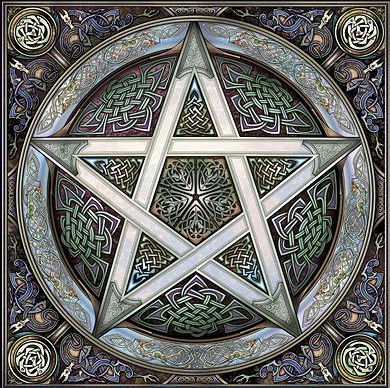


Samhain is a pagan religious festival originating from an ancient Celtic spiritual tradition. In modern times, Samhain (a Gaelic word pronounced “sow-win”) is usually celebrated from October 31 to November 1 to welcome in the harvest and usher in “the dark half of the year.” Celebrants believe that the barriers between the physical world and the spirit world break down during Samhain, allowing more interaction between humans and denizens of the Otherworld.
ANCIENT SAMHAIN
Ancient Celts marked Samhain as the most significant of the four quarterly fire festivals, taking place at the midpoint between the fall equinox and the winter solstice. During this time of year, hearth fires in family homes were left to burn out while the harvest was gathered.
After the harvest work was complete, celebrants joined with Druid priests to light a community fire using a wheel that would cause friction and spark flames. The wheel was considered a representation of the sun and used along with prayers. Cattle were sacrificed, and participants took a flame from the communal bonfire back to their home to relight the hearth.
Early texts present Samhain as a mandatory celebration lasting three days and three nights where the community was required to show themselves to local kings or chieftains. Failure to participate was believed to result in punishment from the gods, usually illness or death.
There was also a military aspect to Samhain in Ireland, with holiday thrones prepared for commanders of soldiers. Anyone who committed a crime or used their weapons during the celebration faced a death sentence.
Some documents mention six days of drinking alcohol to excess, typically mead or beer, along with gluttonous feasts.
SAMHAIN MONSTERS
Because the Celts believed that the barrier between worlds was breachable during Samhain, they prepared offerings that were left outside villages and fields for fairies, or Sidhs.
It was expected that ancestors might cross over during this time as well, and Celts would dress as animals and monsters so that fairies were not tempted to kidnap them.
Some specific monsters were associated with the mythology surrounding Samhain, including a shape-shifting creature called a Pukah that receives harvest offerings from the field. The Lady Gwyn is a headless woman dressed in white who chases night wanderers and was accompanied by a black pig.
The Dullahan sometimes appeared as impish creatures, sometimes headless men on horses who carried their heads. Riding flame-eyed horses, their appearance was a death omen to anyone who encountered them.
A group of hunters known as the Faery Host might also haunt Samhain and kidnap people. Similar are the Sluagh, who would come from the west to enter houses and steal souls.
MYTHS OF SAMHAIN
One of the most popular Samhain stories told during the festival was of “The Second Battle of Mag Tuired,” which portrays the final conflict between the Celtic pantheon known as the Tuatha de Danann and evil oppressors known as the Fomor. The myths state that the battle unfolded over the period of Samhain.
One of the most famous Samhain-related stories is “The Adventures of Nera,” in which the hero Nera encounters a corpse and fairies, and enters into the Otherworld.
Samhain figured into the adventures of mythological Celtic hero Fionn mac Cumhaill when he faced the fire-breathing underworld dweller Aillen, who would burn down the Hall of Tara every Samhain.
Samhain also figures into another Fionn mac Cumhaill legend, where the hero is sent to the Land Beneath the Wave. As well as taking place on Samhain, it features descriptions of the hero’s holiday gatherings.
SAMHAIN IN THE MIDDLE AGES
As the Middle Ages progressed, so did the celebrations of the fire festivals. Bonfires known as Samghnagans, which were more personal Samhain fires nearer the farms, became a tradition, purportedly to protect families from fairies and witches.
Carved turnips called jack-o-lanterns began to appear, attached by strings to sticks and embedded with coal. Later Irish tradition switched to pumpkins.
In Wales, men tossed burning wood at each other in violent games and set off fireworks. In Northern England, men paraded with noisemakers.
DUMB SUPPER
The tradition of “dumb supper” began during this time, in which food was consumed by celebrants but only after inviting ancestors to join in, giving the families a chance to interact with the spirits until they left following dinner.
Children would play games to entertain the dead, while adults would update the dead on the past year’s news. That night, doors and windows might be left open for the dead to come in and eat cakes that had been left for them.
CHRISTIAN SAMHAIN
As Christianity gained a foothold in pagan communities, church leaders attempted to reframe Samhain as a Christian celebration.
The first attempt was by Pope Boniface in the 5th century. He moved the celebration to May 13 and specified it as a day celebrating saints and martyrs. The fire festivals of October and November, however, did not end with this decree.
In the 9th century, Pope Gregory moved the celebration back to the time of the fire festivals, but declared it All Saints’ Day, on November 1. All Souls’ Day would follow on November 2.
HALLOWEEN
Neither new holiday did away with the pagan aspects of the celebration. October 31 became known as All Hallows Eve, or Halloween, and contained much of the traditional pagan practices before being adopted in 19th-century America through Irish immigrants bringing their traditions across the ocean.
Trick-or-treating is said to have been derived from ancient Irish and Scottish practices in the nights leading up to Samhain. In Ireland, mumming was the practice of putting on costumes, going door-to-door and singing songs to the dead. Cakes were given as payment.
Halloween pranks also have a tradition in Samhain, though in the ancient celebration, tricks were typically blamed on fairies.
WICCA AND SAMHAIN
A broad revival of Samhain resembling its traditional pagan form began in the 1980s with the growing popularity of Wicca.
Wicca celebration of Samhain takes on many forms, from the traditional fire ceremonies to celebrations that embrace many aspects of modern Halloween, as well as activities related to honoring nature or ancestors.
Wiccans look at Samhain as the passing of the year, and incorporate common Wiccan traditions into the celebration.
In the Druid tradition, Samhain celebrates the dead with a festival on October 31 and usually features a bonfire and communion with the dead. American pagans often hold music and dance celebrations called Witches’ Balls in proximity to Samhain.
CELTIC RECONSTRUCTIONISTS
Pagans who embrace Celtic traditions with the intent of reintroducing them faithfully into modern paganism are called Celtic Reconstructionists.
In this tradition, Samhain is called Oiche Shamnhna and celebrates the mating between Tuatha de Danaan gods Dagda and River Unis. Celtic Reconstructionists celebrate by placing juniper decorations around their homes and creating an altar for the dead where a feast is held in honor of deceased loved ones.
How to Celebrate Samhain
Samhain is typically celebrated by preparing a dinner to celebrate the harvest. The holiday is meant to be shared with those who have passed on as well as those still with us. Set a place at the table for those in the spiritual plane, providing an offering for them upon every serving throughout the meal. In addition to those who have passed, invite friends and family to enjoy the feast with you. Typical beverages include mulled wine, cider, and mead, and are to be shared with the Dead throughout the meal.
Despite occurring at similar times and containing similar themes, Samhain and Halloween actually are not the same holiday. Halloween, short for All Hallow’s Eve, is celebrated on and around Oct. 31 and tends to be more family-focused. On the other hand, Samhain is more religious in focus, spiritually observed by practitioners.
There are some more light-hearted observances in honor of the dead through Samhain, but the underlying tone of Samhain is one of a serious religious practice rather than a light-hearted make-believe re-enactment. Today’s Pagan Samhain rites, while somber, are benevolent, and, although centered on death, do not involve human or animal sacrifices. Another difference between Samhain and Halloween is that most Samhain rituals are held in private rather than in public.
If you want to start honoring this pagan tradition, you might wonder when to start. Well, the timing of contemporary Samhain celebrations varies according to spiritual tradition and geography. Practitioners state to celebrate Samhain over the course of several days and nights, and these extended observances usually include a series of solo rites as well as ceremonies, feasts, and gatherings with family, friends, and spiritual community.
In the northern hemisphere, many Pagans celebrate Samhain from sundown on October 31 through November 1. Others hold Samhain celebrations on the nearest weekend or on the Full or New Moon closest to this time. Some Pagans observe Samhain a bit later, or near November 6, to coincide more closely with the astronomical midpoint between Fall Equinox and Winter Solstice. Most Pagans in the southern hemisphere time their Samhain observances to coincide with the middle of their Autumn in late April and early May, rather than at the traditional European time of the holiday. In the end, it’s really up to you!
Samhain isn’t necessarily a creepy, morbid holiday obsessed with death, as some may conclude. Instead, it reaches for themes deeper than that, tying in with Nature’s rhythms. In many places, Samhain coincides with the end of the growing season. Vegetation dies back with killing frosts, and therefore, literally, death is in the air. This contributes to the ancient notion that at Samhain, the veil is thin between the world of the living and the realm of the Dead and this facilitates contact and communication. For those who have lost loved ones in the past year, Samhain rituals can be an opportunity to bring closure to grieving and to further adjust to their being in the Otherworld by spiritually communing with them. However, it’s also a way to appreciate life, when you get right down to it.
There are many rituals you can partake in to celebrate Samhain. Here are just a few ideas (and none of them involve life sacrifice):
Samhain Rituals
- Samhain Nature Walk
Take a meditative walk in a natural area near your home. Observe and contemplate the colors, aromas, sounds, and other sensations of the season. Experience yourself as part of the Circle of Life and reflect on death and rebirth as being an important part of Nature. If the location you visit permits, gather some natural objects and upon your return use them to adorn your home.
2. Set Up A Samhain Altar
If you’re new to the pagan tradition and don’t have a permanent altar in place, you can easily set up a table to leave in place for the three days prior to Samhain. Decorate the altar with symbols of late fall, such as:
• Skulls, skeletons, grave rubbings, ghosts
• Harvest food such as pumpkins, squash, root vegetables
• Nuts and berries, dark breads
• Dried leaves and acorns
• A cornucopia filled with an abundance of fruit and veggies
• Mulled cider, wine, or mead
- Samhain Ceremony
Start out by preparing a meal for the family, focusing on fruits and vegetables, and wild game meat if available. Include a loaf of a dark bread like rye or pumpernickel and a cup of apple cider or wine. Set the dinner table with candles and a fall centerpiece, and put all the food on the table at once. Consider the dinner table a sacred space.
Gather everyone around the table, and say this, “Tonight is the first of three nights, on which we celebrate Samhain. It is the end of the harvest, the last days of summer, and the cold nights wait on the other side for us. The bounty of our labor, the abundance of the harvest, the success of the hunt, all lies before us. We thank the earth for all it has given us this season, and yet we look forward to winter, a time of sacred darkness.”
Take the cup of cider or wine, and lead everyone outside. Make this a ceremonial and formal occasion. Head to your garden (if you don’t have one, find a grassy place in your yard). Each person in the family takes the cup in turn and sprinkles a little bit of cider onto the earth, saying, “Summer is gone, winter is coming. We have planted and we have watched the garden grow, we have weeded, and we have gathered the harvest. Now it is at its end.”
Collect any yard trimmings or dead plants and use them to make a straw man or woman. If you follow a more masculine path, he may be your King of Winter, and rule your home until spring returns. If you follow the Goddess in her many forms, make a female figure to represent the Goddess as hag or crone in winter. Once that is done, go back inside and bring your deity into your home. Place him on your table and prop him up with a plate of his own, and when you sit down to eat, serve him first.
Begin your meal with the breaking of the dark bread, and make sure you toss a few crumbs outside for the birds afterwards. Keep the King of Winter in a place of honor all season long — you can put him back outside in your garden on a pole to watch over next spring’s seedlings, and eventually burn him at your Beltane celebration. When you are finished with your meal, put the leftovers out in the garden as an offering for the dead.
- Make an Ancestors Altar
Honor your deceased family members with this ceremony. Gather photographs, heirlooms and other mementos of deceased family, friends, or even pets. Arrange them on a table, dresser, or other surface, along with several votive candles. Light the candles in their memory; while you do so, speak their names out loud and express well wishes and thank them for being part of your life or lineage. Sit quietly and pay attention to what you experience. Note any messages you receive in your journal. This Ancestors Altar can be created just for Samhain or kept year round.
- Guide the Spirits
Place a white seven-day candle in the window to guide the dead to the Spirit World. Light the candle and speak these words, “O little flame that burns so bright, be a beacon on this night. Light the path for all the dead, that they may see now what’s ahead. And lead them to the Summerland and shine until Pan takes their hands. And with Your light, please bring them peace, that they may rest and sleep with ease.”
- Visit a Cemetery
Another way to honor the passing of family and friends is to visit and tend their gravesite at a cemetery. Call to mind memories and consider ways the loved one continues to live on within you. Place an offering there such as fresh flowers, dried herbs (rosemary is one great choice), or fresh water.
- Hit ‘Pause’
As we mentioned, Samhain is also a time to celebrate life in contrast to death, which makes it a great moment to stop and introspect. Reflect on you and your life over the past year. Review journals, planners, photographs, blogs, and other notations you have created during the past year. Consider how you have grown, accomplishments, challenges, adventures, travels, and learnings. Meditate. Journal about your year in review, your meditation, and your reflections.
- Hold a Séance
Also as we mentioned, Samhain is thought to be a time of little distance between the living and the dead. If there’s anyone on the other side you’d like to communicate with, now is an excellent time, according to the pagan tradition.
- Bonfire Magic
Kindle a bonfire outdoors when possible or kindle flames in a fireplace or a small cauldron. Write down an outmoded habit that you wish to end and cast it into the Samhain flames as you imagine release. Imagine yourself adopting a new, healthier way of being as you move around the fire clockwise.
- Divinatory Guidance
Using tarot, runes, scrying, or some other method of divination, seek and reflect on guidance for the year to come. Write a summary of your process and messages. Select something appropriate to act upon and do it.
- Divine Invocations
Honor and call upon the divine in one or more sacred forms associated with Samhain, such as the Crone Goddess and Horned God of Nature. Invite them to aid you in your remembrance of the dead and in your understanding of the cycle of life, death, and rebirth. If you have lost loved ones in the past year, ask these deities to comfort and support you.
- Herbs and Spices
There are many plants that tie in closely with Samhain. To name a few: allspice berries, broom, catnip, mountain ash berries, mugwort, mullein, oak leaves, acorns, rosemary, sage, pine cones, and straw. Find creative (and safe; research each before consuming) ways to use them in your cooking and around your house as decorations.
- Community Connections
Connect with others. Join in a group ritual in your area. Organize a Samhain potluck in your home. Research old and contemporary Samhain customs in books, periodicals, on-line, and through communications with others. Exchange ideas, information, and celebration experiences. Regardless of whether you practice solo or with others, as part of your festivities, reflect for a time on being part of the vast network of those celebrating Samhain around the world.
 Learning Wicca and the Tradition of the Craft