
- The Altar
The altar is vital for any witch, pagan, or wiccan. It’s your sacred space, where you interact with your guides and perform your spells. It is the focus of your personal power. For a witch, not having an altar is the same as not having a home. You can’t go without it. However, your altar doesn’t have to be complicated, or beautiful, to be effective.
Remember, it is personal to you. So do what you feel comfortable with.


- Altar Cloth
A cloth is an easy way to decorate your altar. You can choose various colors and materials according to the purpose of your ritual. Scarves, spare cloths, or a special made pagan cloth will do. Whatever feels right for you
- Blades

Blades are important tools in ritual magick. The blade represents masculine energy, movement, and the act of cutting something (metaphorically). Just like the Swords tarot suit, blades are associated with the element of air.
- Besom or broom

The broom symbolizes the union of the God and the Goddess. Its phallic shape is associated with masculinity while its three-parts design symbolizes the three cycles of femininity. Associated with the element of water, the broom is used to spirituality cleanse your space, before rituals and spellwork. To do so, simply swipe around the room in a clockwise direction. When you are done, open the nearest door and swipe everything outside, to ensure that the negativity doesn’t come back. Be sure to consecrate your broom before using it, and make sure that it’s not used for the mundane cleansing, but only in a ritual manner. Suspended on top of your front door, the broom acts as a guardian against negative influences. The broom also plays an important part in pagan weddings. In handfasting ceremonies, the newly wed couple jumps on top of the besom to attract fertility, prosperity and harmony in their household. If you want to craft your own, the traditional recipe includes :
- A four-foot length of ash or oak for the handle
- Thin branches of birch, mugwort or thyme for the bristle part
- Lengths of willow or heavy cord to bind everything together
- Altar Tile

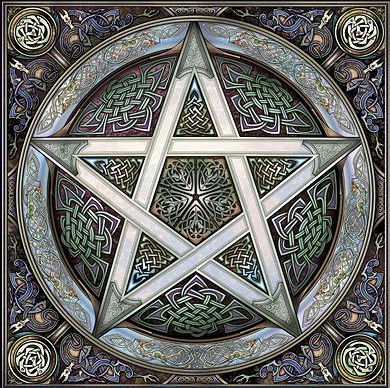
The altar tile is usually round or square in shape. It can be made of various, natural materials, like wood, stone, ceramic and metal. It is often engraved with power symbols such as the pentagram or the wheel of the year. It has a grounding power and helps the energy to stay focussed. When my ritual is done, and my circle is open, I have found that touching my altar tile helps me in sending back the energies to the earth.
- Book of Shadows/Grimoire
The Book of shadows may be the most important item of your altar. This is where you record your personal Wiccan/pagan rituals, any spells, sigils, etc. That you think up. This is where you’ll want to keep notes, but it is not a textbook. This is your story of your path. It must be personal, private, and treasured closely.
- Athame
The athame is a double-edged blade used for casting the circle. Traditionally, the athame had a black handle. Your athame should not be sharpened, because it’s not made to cut physical things. However, I often use mine to carve runes and sigils on candles
- Boline
The boline is a small sickle with a blade in the shape of a half-moon. Traditionally, its handle is white. It is used to harvest herbs, flowers and branches. Nowadays a lot of witches use letter openers or more mundane knives instead.
- Sword
The sword is a larger, more formal version of the athame. It is generally used for marking the limits of the sacred circle during large, public outdoor rituals. Unlike the athame, usually, only the High Priest and High Priestesses of a coven has the right to carry it.
- Candles/Candle Holders
Candles are another must have for any witch out there. Cheap and easy to use, they are the perfect tool of witchcraft. You can use them in a lot of different ways: to summon guardians, deities and various entities, to symbolize the element of fire, to manifest a goal (candle magick), to light your way during astral projection, and much more. On top of it they are very useful to set you in the appropriate mood before performing a spell.
Some witches believe that simply blowing out the candles is disrespectful to the fire spirits. For this reason, it is common to use a candle snuffer instead. Personnaly, I believe that if you say “thank you” to the fire spirits before blowing the candles, it is totally acceptable.
- Cauldron

Traditionally, a book of shadows was a document containing religious texts, rituals and spells from a specific wiccan tradition. Nowadays, a lot of witches also use it like a journal of their magickal and ritual practices. Magickal journaling in itself is a great tool for all witches. You’d be surprised to see how much magickal work can be done with just a pen, some paper, and your book of shadows. Simple affirmations written on paper can be very powerful. Add a sigil or a rune and believe me, you will attain results. But more on that in another post.
- Chalice
The chalice or cup also represents the sacred womb of the Goddess. Like the Cups tarot suit, the chalice is associated with the element of water. The chalice can be made of any natural material. Stainless steel is very common, but glass and ceramic are good options too. Fill your cup with water to represent this element in the sacred circle. The cup can also be used for libations, which consist in pouring small drops of a beverage into the ground to honor the Gods, then passing it around the circle so that everyone can take a sip.
- Various Containers
Bottles, boxes, chests, jars and pouches are very useful for any practitioner of the Arts. Not only are they useful to harvest and store ingredients, but they can also be active tools for your spells. A lot of workings require the use of a container, be they witches bottles, manifestation boxes, honey jars, reiki boxes, spiritual baths, witchy brews, etc. For example, in my coven, we have a little “wishing chest” that we use on every Ostara. Each year, everybody writes a wish on a piece of paper and puts it into the chest. The following year, we open the chest together, and we reflect on our wish. Then we make another wish for the next Ostara. This is one of the many ways that you can use containers and boxes as tools for witchcraft.
- Crystals
There is a lot to say about crystals. They are more than mere rocks. Take the time to know your crystals, and in each of them, you’ll find a friend. Each of them possesses a unique frequency. In aligning with your crystals, you will experience healing on a deep level. Crystals are like small batteries, infused with the power of the Earth. They can be found in all shapes, colors and sizes. You can use them as focuses for any spiritual work. If you own crystals, don’t forget to clean them on a regular basis.
- Divination Tools
Divination tools are organized systems that are used to receive information. They are an extension of your natural six psychic senses. The most popular divination systems are crystal balls, oracle cards, pendulums, runes, scrying mirrors or bowls and tarot decks. All divination systems have their strengths and weaknesses, and no tool is better than the others. Feel free to try different systems to find which one resonates the most with you.
- Dolls
Dolls are useful in witchcraft as more than the stereotyped voodoo doll here. In witchcraft, dolls are 3D images that serve to focus your intentions. Dolls can represent any entity, may it be human or spiritual. Use a doll to represent someone as the target for your spell (don’t do it without their permission though). You can even use a doll to represent yourself. You can play with color meanings and physical parts associations (chakras, for example) to manifest specific things to your target. You can also use dolls to represent deities on your altar.
- Herbs and Essential Oils
Just like crystals, herbs and oils possess their own magickal associations. Herbal magick is a whole branch in witchcraft. There is a lot of different ways to include herbs and oils in your spells. Usually, herbs are used in a dried state, and essential oils are diluted in vegetable oil. You can use herbs and oils for spiritual baths, magickal teas, kitchen witchcraft, incense (see below), talismans, and much more.
- Incense and Smudge Sticks
Incense plays an important part in all spiritual practices. This is not surprising since it is a very powerful tool. Incenses are made of dried herbs, resins, and essential oils, and their properties depend on their composition. They are available in a lot of different forms, and smudge sticks fall under the same category. Keep in mind that there is no real difference between herb bundles, incense sticks, cones, or powders. Just use what’s at your disposition and trust the process.
In the same vein, the censer is a fireproof container used to hold hot charcoal, for burning powders and incense cones. There are a lot of different models that you can use for this purpose. Personally, I use a small cast iron cauldron as a censer. In Wicca, the incense and censer are associated with the element of Air. Incense is burned to purify the practitioner and the space, before casting the circle. Then, incense is passed around the circle’s boundaries, to consecrate it.
In addition, you can also use incense to help you manifest your goals. If you frequent metaphysical shops and websites, you will notice that they sell incense for every purpose (by example, love, career, etc.). Used in this way, incense becomes a form of magick by itself. For it to work, you simply need to focus on your intention. Light the incense, and meditate on it while you let it completely burn.
- Instruments and Music
Music in all its forms is a great magickal tool. From recorded music to bells, drums, singing bowls, or your own voice, music holds magick. It’s just another kind of intention, expressed with musical sounds. The altar bell is associated with the element of water because it’s made of metal. It can be used in two ways: to summon or to banish spirits. Wiccans ring the bell after calling the elemental guardians. It is customary to ring the bell to delimitate the different parts of a ritual, like a punctuation mark. To banish negative spirits from a space, you can ring a bell, clap your hands or a drum, or emit a loud sound in each corner of the room.
- Mortar and Pestle

The mortar and pestle are used to crush herbs and resins to make herbal powders. You can use it to fabricate incense and various brews and potions. While you are crushing your herbs, be mindful of the intent you are putting in it. With the right mindset, the act of crushing the herbs can reinforce your spell. On a side note, if you are cooking ritual food, be sure to use a different mortar and pestle, because some plants and resins used in herbal magick can be toxic if eaten. Kitchen Witches: This means have two Mortals and pestles if you prefer to grind your herbs and spices for cooking!
- Offering Bowl

The offering bowl is a must-have for any devotional shrine.Hopefully, you can use almost anything. An offering bowl is simply a container where you’ll place your offerings. You can use the same bowl for all your deities or choose a different one to each entity that you work with. Furthermore, it doesn’t have to be a bowl at all. You can use anything that speaks to you: a flat rock, a trunk, a dish that you particularly like, a small chest, etc. My offering bowl to Venus is a clamshell, and I use it every day.
- Ritual Clothing
When performing a spell, some witches wear items that are specifically made for ritual purposes. It can be a ritual cloak, mask, robe, or hat, or a piece of jewelry including occult symbols or crystals. Other witches prefer to perform skyclad (ritual nudity), so that they appear in humility before the gods. Nothing is wrong in performing a spell in casual clothing, but ritual clothing helps to attain the appropriate mindset for spellwork. Furthermore, the color of your clothes can affect the way the energy behaves into the sacred circle. Usually, in public rituals, the custom is to wear plain black clothes, because it absorbs light and keeps the practitioners away from distraction.
- Rope
Just like containers, ropes are very useful for witches. You can use it to tie herbal pouches and talismans, but also to perform spells. With a decent length of rope, you can make witches ladders and knot magick. Knot magick are spells that are performed while tying multiple knots on a rope. This type of magick originates from sailor’s superstitions, and nowadays it’s become a part of sea witchcraft. In a broader perspective, two popular rituals involving rope are the Beltane Maypole and the handfasting ceremonies. In a handfasting ceremony, the hands of the bride and groom are clasped together using one or many ropes. The knot represents the unity of the couple, who is now bound together.
- Statues/ Visual Representations
Statues are a great addition to a witches altar. Most of the time, they’re not used as active witchcraft tools, but they can help you to visualise the entities that you are working with. If you can’t afford to buy a statue for your patron deity, you can easily craft your own. You can also use a tarot or oracle card or draw the entity as it appears to you in your mind’s eyes. Besides, statues and visual representations makes great offerings.
- Wand/Staff

The wand is not only used in Harry Potter. In fact, it is an important tool in witchcraft, especially in Wicca. Traditionally, wands are made of wood, but they can also be made of any natural material like glass, metal, or stone. Wands and staffs are associated with fire and the wands tarot suit. In wicca, it represents masculinity, and it is used to direct the energy, just like the athame. I usually use my wand to summon the entities and to consecrate other tools. Just like the broom, you can easily craft your own wand. Choose its material for its properties, according to the type of work that you will perform with your wand.
- Bells

Bells are repellers of witches and evil spirits. Bells are associated with the divine: their sound is symbolic of creative power, their shape a symbol of the female force and the celestial vault. The sound vibrations created by the ringing of bells have been believed for centuries to possess magical and/or spiritual power. Bells are used in many religious rites. In Wicca and Paganism, small hand bells may be rung in rituals to enhance harmony and augment power. In African religions and Vodun, bells and dancing are used to invoke the gods and has. Shamans have long used magical bells in their rituals to chase away evil spirits.
In folk magic, the ringing of bells drives away evil spirits, witches and the Devil himself, and wards off the Evil Eye. Bells have been attached to clothing, worn as amulets, tied to children and hung from the necks of horses, camels, cows, asses and other animals important to a community.
As fertility charms, bells have been worn on human phalluses in certain rites. Bells are sometimes said to have curative powers; medicine is drunk from them. In the Middle Ages, bell ringing was believed to clear the air of disease and was prescribed by some doctors. Bells also have been used to raise the spirits of the dead and Fairies.
- Mirrors
One of the most ancient forms of Divination is crystallomancy or catoptromancy, performed with a magic mirror. The magi of Persia are said to have used mirrors, as well as the ancient Greeks and romans. In ancient Greece, the witches of Thessaly wrote their oracles in human blood upon mirrors. The Thessalian witches are supposed to have taught Pythagoras how to divine by holding a magic mirror up to the moon. Romans who were skilled in mirror reading were called specularii.
In lore, mirrors are believed to reflect the soul and must be guarded against lest the soul be lost. These fears carry over into superstitious customs, such as covering the mirrors in a house after death to prevent the souls of the living from being carried off by the ghost of the newly departed; and removing mirrors from a sickroom because the soul is more vulnerable in times of illness. According to another superstition, if one looks into a mirror at night, one will see the Devil. In Russian folklore, mirrors are the invention of the Devil, having the power to draw souls out of bodies. The Aztecs used mirror-like surfaces to keep witches away. A bowl of water with a knife in it was placed in the entrances of homes. A witch looking into it would see her soul pierced by the knife, and flee. According to another belief, witches have no souls, and therefore, like vampires, have no reflections in mirrors.
- Charcoal
The purpose of charcoal is to burn herbs, incense or oils. It is usually found in a compressed small disc that burns for about 45 minutes. Modern witches can find quick light options that burn uniformly.
- Paper
Many spells call for the witch to write something down: wishes and goals or things you want to release. It’s good to have some different kinds of paper on hand for a variety of purposes. Some paper burns faster or slower, some paper shouldn’t be burned at all. Some can be buried and seeds grow from it, some changes color, some dissolve in water. If you want to charge your paper for magical use, simply wave it through the smoke of some incense for a short period of time (careful not to light it on fire indoors if the spell calls for it’s burning!).
- Pen and Ink
You may wish to keep a variety of pens in different colors based on color magic uses. You can charge your pens for magical use similarly to charging paper. Some witches will separate pen and ink to charge individually, this is personal preference. You can also buy or make ink that is created specifically for magical purposes if you prefer.
- Pentacle
There is some confusion about the difference between a pentagram and a pentacle. A pentagram is a five-pointed star. A pentacle is a five-pointed star enclosed in a circle (PENTA-gram + cir-CLE = pentacle) This symbol is used for all sorts of purposes dependent on your belief system. One common practice is as a charging station for other objects (like the chalice, a crystal or an amulet).
- Salt
It is a symbol of the Earth. It is used to create Lustral Water and for Rituals.
- Books
You can never have enough knowledge in witchcraft. Some reputable authors to begin with are Scott CUnningham, Margot Alder , Raymond Buckland, Lisa Lister, Arin Murphy-Hiscock, Yasmin Boland, Lisa Chamberlain, and Silver Ravenwolf.
 Learning Wicca and the Tradition of the Craft