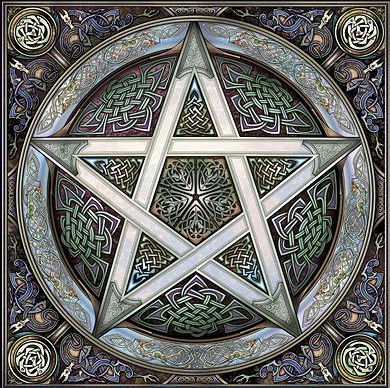

The truth is, there are HUNDREDS of sacred places dedicated to paganism and/or Wicca. These places can be an elaborate temple or a simple tree in your yard. The spirituality of a place really depends on you and the way you feel at that location; whether or not you feel a connection to the place.
For Wicca in general, it is important that there are no temples as we think of them. It is mainly about worshiping in places that WE enjoy (I cannot stress that enough). These places could be under the moon, under the sun, in the rain or snow, in a field or forest, near water, with others in a place you all find comfortable, alone in a place that you find comfortable. Churches are not common in the WIccan practice. This doesn’t mean they do not exist, of course, but the true church is much like your craft; it is a place of your own.
Why arent there specific places for Wiccans to flock to for worship? Well, that would be because our places are everywhere and anywhere. Wicca should be ingrained into your everyday practices, therefore, everywhere is a place of worship to you. Wiccan faith is also firmly rooted in the living, thriving nature. Gathering in a wooden box of a building for worship often feels wrong to many Wiccans.
Remember; it is the worship that matters, not the way or place on worships.
This is not to say that there aren’t man-made places that pagans in general (not excluding Wiccans) find to be spiritual or sacred.
Stonehenge-United Kingdom

In about 2500 BC the stones were set up in the centre of the monument. Two types of stone are used at Stonehenge – the larger sarsens and the smaller ‘bluestones’. The sarsens were erected in two concentric arrangements – an inner horseshoe and an outer circle – and the bluestones were set up between them in a double arc.
About 200 or 300 years later the central bluestones were rearranged to form a circle and inner oval (which was again later altered to form a horseshoe). The earthwork Avenue was also built at this time, connecting Stonehenge with the river Avon.
One of the last prehistoric activities at Stonehenge was the digging around the stone settings of two rings of concentric pits, the so-called Y and Z holes, radiocarbon dated by antlers within them to between 1800 and 1500 BC. They may have been intended for a rearrangement of the stones that was never completed.
Four of the sarsens at Stonehenge were adorned with hundreds of carvings depicting axe-heads and a few daggers. They appear to be bronze axes of the Arreton Down type, dating from about 1750–1500 BC. Perhaps these axes were a symbol of power or status within early Bronze Age society, or were related in some way to nearby round barrow burials.
From the middle Bronze Age, less communal effort went into the construction of ceremonial monuments such as Stonehenge and more on activities such as the creation of fields.
In the Iron Age, probably about 700 BC, a major hillfort later known as Vespasian’s Camp was constructed 1¼ miles east of Stonehenge overlooking the river Avon. Stonehenge appears to have been frequently visited in the Roman period (from AD 43), since many Roman objects have been found there. Recent excavations raised the possibility that it was a place of ritual importance to Romano-British people.
The small town of Amesbury is likely to have been established around the 6th century AD at a crossing point over the Avon. A decapitated man, possibly a criminal, was buried at Stonehenge in the Saxon period. The earliest surviving written references to Stonehenge date from the medieval period, and from the 14th century onwards there are increasing references to Stonehenge and drawings and paintings of it.
Meanwhile, the introduction of turnpike roads and the railway to Salisbury brought many more visitors to Stonehenge. From the 1880s, various stones had been propped up with timber poles, but concern for the safety of visitors grew when an outer sarsen upright and its lintel fell in 1900. The then owner, Sir Edmund Antrobus, with the help of the Society of Antiquaries, organised the re-erection of the leaning tallest trilithon in 1901.
This was the start of a sequence of campaigns to conserve and restore Stonehenge – the last stones were consolidated in 1964.
The monument remained in private ownership until 1918 when Cecil Chubb, a local man who had purchased Stonehenge from the Atrobus family at an auction three years previously, gave it to the nation. Thereafter, the duty to conserve the monument fell to the state, today a role performed on its behalf by English Heritage.
From 1927, the National Trust began to acquire the land around Stonehenge to preserve it and restore it to grassland. Large areas of the Stonehenge landscape are now in their ownership. More recent improvements to the landscape – including the removal of the old visitor facilities and the closure of the section of the old A344 that ran close to the stones – have begun the process of returning Stonehenge to an open grassland setting, but there is more that can be done. English Heritage welcomes government plans to invest in a tunnel, which would remove much of the busy A303 and help reconnect the monument to its ancient landscape.
Each year on the 21st June visitors from around the world gather at Stonehenge overnight to mark the summer solstice and to see the sunrise above the stones. At dawn the central Altar stone aligns with the Slaughter stone, Heel stone and the rising sun to the northeast.
The white cloaked and hooded druids gather among the standing stones to celebrate the summer solstice at dawn.
They joyously welcome the first rays of the sunlight
by tapping the heel stone while chanting “ARISES “O” SUN”, amidst the early morning dawn chorus of the birds.
The Stonehenge Summer Solstice is a very popular event to attend and people from all over the world gather at this ancient site to witness and be part of an age-old ritual.
The Winter solstice is also celebrated at the sacred Stonehenge. For pricing ideas for summer solstice, follow this link. For the Winter solstice, check here.
Angkor Wat-Cambodia

The Khmer Empire’s various capitals thrived here from the 9th to 15th centuries, while their rulers presided over an empire that stretched from Myanmar (Burma) to Vietnam. Including forested areas and newly discovered “suburbs” Angkor covers more than 400 square kilometers.
Though just one of hundreds of surviving temples and structures, the massive Angkor Wat is the most famed of all Cambodia’s temples—it appears on the nation’s flag—and it is revered for good reason. The 12th century “temple-mountain” was built as a spiritual home for the Hindu god Vishnu. The temple is an architectural triumph laden with artistic treasures like the bas-relief galleries that line many walls and tell enduring tales of Cambodian history and legend.
One tale Angkor’s artists and scribes did not tell, however, is why the city’s rulers abandoned the site and resettled near modern Phnom Penh. Theories include defeats in battle and shifting religious observances, (because the Khmer’s Hinduism was gradually replaced by Theravada Buddhism during the 13th and 14th centuries), but the mystery has puzzled scientists for centuries.
Angkor is as much about water as it is about stone—the site boasts an enormous system of artificial canals, dikes, and reservoirs, the largest of which (West Baray) is 5 miles (8 kilometers) long and 1.5 miles (2.4 kilometers) wide. These incredible feats of engineering form an integral part of an overall site design that remains faithful to religious symbolism. Moats, for example, simulate the oceans surrounding Mount Meru, the home of Hindu gods.
But these massive works also served a practical purpose by skillfully harnessing river and rainwater to quench the thirst of some 750,000 residents in the world’s largest preindustrial city. That water also irrigated wealth-producing crops like rice, which served the Khmer as currency.
Some scholars speculate that the downfall of this elaborate water system led to the end of Angkor. A series of weak monsoons and/or the collapse of the water works due to environmental issues, like deforestation, which drove destructive floods and choked the system with sediment, might have tipped the movement of power toward Phnom Penh.
Even after its glory days had passed, Angkor remained popular with Buddhist pilgrims who journeyed from across Southeast Asia and beyond. Today the site also draws secular travelers—almost a million a year.
When Angkor was named a World Heritage site in 1992 it was also added to the List of World Heritage in Danger; the incomparable site was threatened by pillaging, plagued by illegal excavations, and even dotted with land mines. In 1993 UNESCO launched a major campaign to restore and safeguard Angkor. Thanks to a textbook case of international cooperation Angkor rebounded so dramatically that it was removed from the List of World Heritage in Danger in 2004.
Newgrange-Ireland

Newgrange is a 5,200 year old passage tomb located in the Boyne Valley in Ireland’s Ancient East.
Newgrange was built by Stone Age farmers, the mound is 85 meters (93 yards) in diameter and 13.5 meters (15 yards) high, an area of about 1 acre.A passage measuring 19 meters (21 yards) leads into a chamber with 3 alcoves. The passage and chamber are aligned with the rising sun at the Winter Solstice.
Newgrange is surrounded by 97 large stones called kerbstones some of which are engraved with megalithic art; the most striking is the entrance stone.
Newgrange is a Stone Age (Neolithic) monument in the Boyne Valley, County Meath, it is the jewel in the crown of Ireland’s Ancient East. Newgrange was constructed about 5,200 years ago (3,200 B.C.) which makes it older than Stonehenge and the Great Pyramids of Giza. Newgrange is a large circular mound 85 meters (93 yards) in diameter and 13.5 meters (15 yards) high with a 19 meter (21 yard) stone passageway and chambers inside. The mound is ringed by 97 large kerbstones, some of which are engraved with symbols called megalithic art.
Newgrange was built by a farming community that prospered on the rich lands of the Boyne Valley. Knowth and Dowth are similar mounds that together with Newgrange have been designated a World Heritage Site by UNESCO.
Archaeologists classified Newgrange as a passage tomb, however Newgrange is now recognised to be much more than a passage tomb. Ancient Temple is a more fitting classification, a place of astrological, spiritual, religious and ceremonial importance, much as present day cathedrals are places of prestige and worship where dignitaries may be laid to rest.
Newgrange is best known for the illumination of its passage and chamber by the winter solstice sun. Above the entrance to the passage at Newgrange there is an opening called a roof-box. This baffling orifice held a great surprise for those who unearthed it. Its purpose is to allow sunlight to penetrate the chamber on the shortest days of the year, around December 21st, the winter solstice. At dawn, from December 19th to 23rd, a narrow beam of light penetrates the roof-box and reaches the floor of the chamber, gradually extending to the rear of the chamber.
As the sun rises higher, the beam widens within the chamber so that the whole room becomes dramatically illuminated. This event lasts for 17 minutes, beginning around 9am. The accuracy of Newgrange as a time-telling device is remarkable when one considers that it was built 500 years before the Great Pyramids and more than 1,000 years before Stonehenge.
The intent of the Stone Age farmers who build Newgrange was undoubtedly to mark the beginning of the new year. In addition, it may have served as a powerful symbol of the victory of life over death.
Each year the winter solstice event attracts much attention at Newgrange. Many gather at the ancient tomb to wait for dawn, as people did 5,000 years ago.
Machu Picchu-Peru

Embedded within a dramatic landscape at the meeting point between the Peruvian Andes and the Amazon Basin, the Historic Sanctuary of Machu Picchu is among the greatest artistic, architectural and land use achievements anywhere and the most significant tangible legacy of the Inca civilization. Recognized for outstanding cultural and natural values, the mixed World Heritage property covers 32,592 hectares of mountain slopes, peaks and valleys surrounding its heart, the spectacular archaeological monument of “La Ciudadela” (the Citadel) at more than 2,400 meters above sea level. Built in the fifteenth century Machu Picchu was abandoned when the Inca Empire was conquered by the Spaniards in the sixteenth century. It was not until 1911 that the archaeological complex was made known to the outside world.
The approximately 200 structures making up this outstanding religious, ceremonial, astronomical and agricultural centre are set on a steep ridge, crisscrossed by stone terraces. Following a rigorous plan the city is divided into a lower and upper part, separating the farming from residential areas, with a large square between the two. To this day, many of Machu Picchu’s mysteries remain unresolved, including the exact role it may have played in the Incas’ sophisticated understanding of astronomy and domestication of wild plant species.
The dwellings at Machu Picchu were probably built and occupied from the mid-15th to the early or mid-16th century. Machu Picchu’s construction style and other evidence suggest that it was a palace complex of the ruler Pachacuti Inca Yupanqui (reigned c. 1438–71). Several dozen skeletons were excavated there in 1912, and, because most of those were initially identified as female, Bingham suggested that Machu Picchu was a sanctuary for the Virgins of the Sun (the Chosen Women), an elite Inca group. Technology at the turn of the 21st-century, however, identified a significant proportion of males and a great diversity in physical types. Both skeletal and material remains now suggest to scholars that Machu Picchu served as a royal retreat. The reason for the site’s abandonment is also unknown, but lack of water may have been a factor.
Few of Machu Picchu’s white granite structures have stonework as highly refined as that found in Cuzco, but several are worthy of note. In the southern part of the ruin is the Sacred Rock, also known as the Temple of the Sun (it was called the Mausoleum by Bingham). It centres on an inclined rock mass with a small grotto; walls of cut stone fill in some of its irregular features. Rising above the rock is the horseshoe-shaped enclosure known as the Military Tower. In the western part of Machu Picchu is the temple district, also known as the Acropolis. The Temple of the Three Windows is a hall 35 feet (10.6 metres) long and 14 feet (4.2 metres) wide with three trapezoidal windows (the largest known in Inca architecture) on one wall, which is built of polygonal stones. It stands near the southwestern corner of the Main Plaza. Also near the Main Plaza is the Intihuatana (Hitching Post of the Sun), a uniquely preserved ceremonial sundial consisting of a wide pillar and pedestal that were carved as a single unit and stand 6 feet (1.8 metres) tall. In 2000 this feature was damaged during the filming of a beer commercial. The Princess’s Palace is a bi-level structure of highly crafted stonework that probably housed a member of the Inca nobility. The Palace of the Inca is a complex of rooms with niched walls and a courtyard. At the other end of Machu Picchu, another path leads to the famous Inca Bridge, a rope structure that crosses the Urubamba River. Many other ruined cities—like that atop the dark peak of Huayna Picchu, which is accessible by a lengthy, precipitous stairway and trail—were built in the region; Machu Picchu is only the most extensively excavated of these.
The Parthenon-Greece

At the approximate position where the Parthenon was built later, the Athenians began the construction of a building that was burned by the Persians while it was still under construction in 480 BCE. It was presumably dedicated to Athena, and after its destruction much of its ruins were utilized in the building of the fortifications at the north end of the Acropolis. Not much is known about this temple, and whether or not it was still under construction when it was destroyed has been disputed. Its massive foundations were made of limestone, and the columns were made of Pentelic marble, a material that was utilized for the first time. The classicalParthenon was constructed between 447-432 BCE to be the focus of the Acropolis building complex. The architects were Iktinos and Kallikrates (Vitruvius also names Karpion as an architect) and it was dedicated to the goddess Athena Pallas or Parthenos (virgin). The temple’s main function was to shelter the monumental statue of Athena that was made by Pheidias out of gold and ivory. The temple and the chryselephantine statue were dedicated in 438, although work on the sculptures of its pediment continued until completion in 432 BCE.
The Parthenon is a temple of the Doric order with eight columns at the façade, and seventeen columns at the flanks, conforming to the established ratio of 9:4. This ratio governed the vertical and horizontal proportions of the temple as well as many other relationships of the building like the spacing between the columns and their height.
The cella was unusually large to accommodate the oversized statue of Athena, confining the front and back porch to a much smaller than usual size. A line of six Doric columns supported the front and back porch, while a colonnade of 23 smaller Doric columns surrounded the statue in a two-storied arrangement. The placement of columns behind the statue was an unusual development since in previous Doric temples they only appeared on the flanks, but the greater width and length of the Parthenon allowed for a dramatic backdrop of double decked columns instead of a wall.
The back room sheltered Athena’s treasure and four columns of the Ionic order supported its roof. The introduction of elements of the Ionic order in a predominately Doric temple was more dramatic in the development of a continuous freeze on the exterior wall of the cella. While the integration of Doric and Ionic elements on the same temple was not a new development in Greek architecture, it was rare, and bestowed on the Parthenon a delicate balance between austere and delicate visual characteristics.
All temples in Greece were designed to be seen only from the outside. The viewers never entered a temple and could only glimpse the interior statues through the open doors. The Parthenon was conceived in a way that the aesthetic elements allow for a smooth transition between the exterior and the interior that housed the chryselephantine statue of Athena. A visitor to the Acropolis who entered from the Propylaia would be confronted by the majestic proportion of the Parthenon in three quarters view, with full view of the west pediment and the north colonnade. As the viewer moved closer, the details of the sculpted metopes would become decipherable, and when in proximity to the base of the columns, parts of the frieze would become evident in tantalizing colorful glimpses peering from the spaces between the columns.
Moving towards the east and looking up towards the exterior of the cella, a visitor would be mesmerized with the masterful depiction of the Panathenaic procession as it appeared in cinematic fashion on the frieze which was visually interrupted by the Doric columns of the exterior. This was certainly a scene that every Athenian could relate to through personal experience, making thus the transition between earth and the divine a smooth one. A visitor moving east would eventually turn the corner to face the entrance of the Parthenon, and there he would be confronted with the birth of Athena high above on the east pediment, and just beyond it, the arrephores folding the peplos among the Olympian gods and the heroes of the frieze. Then, just below, the “peplos” scene, through the immense open doors, any visitor would be enchanted by the glistening gold and ivory hues of the monumental statue of Athena standing at the back of the dim cella. The statue of Athena Pallas reflected its immense stature on the tranquil surface of the water-pool floor, and was framed by yet more Doric columns, this time smaller, in a double-decked arrangement that made the interior space seem as if it were even larger and taller than the exterior.
It seems certain that the master planners of the Parthenon conceived it as a theatrical event. The temple was constructed with the movements of the viewer in mind, and by the arrangement of the temple, the monumental sculptures of the pediment, and the detailed frieze, the emotions of the visitors were choreographed to prepare them for the ultimate glimpse of the majestic Athena Parthenos at the interior of the naos, and to maximize the effect of an awe inspiring visit.
The Great Serpent Mound-United States

Serpent Mound is an internationally known National Historic Landmark built by the ancient American Indian cultures of Ohio. It is an effigy mound (a mound in the shape of an animal) representing a snake with a curled tail. Nearby are three burial mounds—two created by the Adena culture (800 B.C.–A.D. 100), and one by the Fort Ancient culture (A.D. 1000–1650).
Thousands of years ago, Native Ohioans populated the landscape with mounds and massive earthworks. In the late 19th century, Harvard University archaeologist Frederic Ward Putnam excavated Serpent Mound, but he found no artifacts in the Serpent that might allow archaeologists to assign it to a particular culture. Based largely on the nearby presence of Adena burial mounds, later archaeologists attributed the effigy to the Adena culture that flourished from 800 B.C. to A.D. 100. This theory on the site’s origin was accepted until a 1991 site excavation used radiocarbon dating to determine that the mound was approximately 900 years old. This would suggest that the builders of the Serpent belonged to the Fort Ancient culture (A.D. 1000–1500). In 2014, another team of archaeologists presented new radiocarbon dates for the Serpent suggesting that it was built by the Adena culture at around 300 B.C. More work is needed to clarify the age of Serpent Mound.
The significance of Serpent Mound and other ancient Ohio earthworks has garnered international attention. In 2008, Serpent Mound and eight other Ohio American Indian earthworks were selected by the United States Department of the Interior for inclusion on the United States’ Tentative List of sites to be submitted to the United Nations Educational, Scientific, and Cultural Organization (UNESCO) for inscription on the prestigious World Heritage List. If it is eventually inscribed on the World Heritage List later this decade, Serpent Mound will join the ranks of the Pyramids of Egypt, the Great Wall of China, Pompeii, Stonehenge and the Taj Mahal, all of which are World Heritage sites. World Heritage status has the potential to elevate local and international awareness about the site’s value, further encourage communities to protect and invest in its preservation and increase potentially beneficial tourism to the site.
 Learning Wicca and the Tradition of the Craft